
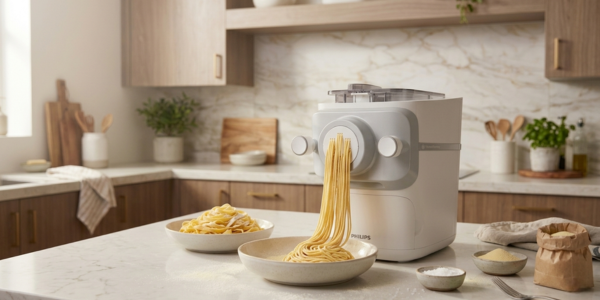
If you’ve ever wanted to eat fresh homemade pasta on a weeknight — without spending 45 minutes kneading, rolling, and cleaning up — the Philips 7000 Series Pasta Maker (HR2660/03) was built for exactly that. You add flour and water, press a button, and in under 10 minutes, fresh pasta is ready to cook. No technique required.
The Everyday Challenge This Product Fixes
Dried pasta from a box is fine. But anyone who’s tasted truly fresh pasta knows the difference — the texture, the way it holds sauce, the flavor. The problem has always been the effort: making pasta by hand means kneading dough for 10+ minutes, resting it, rolling it thin, cutting it carefully, and cleaning a flour-dusted counter afterward.
Most people skip it. Not because they don’t want fresh pasta, but because the process doesn’t fit into a normal evening. That’s the gap this machine targets.
Why the Philips 7000 Pasta Maker Stands Out in Your Kitchen
What separates this from a basic pasta press is ProExtrude Technology — a combination of a 150W motor, a metal mixing paddle, and a reinforced metal front panel. The result is a machine that mixes, kneads, and extrudes dough in a single automated cycle, producing pasta with consistent texture and proper elasticity.
The Perfect Mixing Technology optimizes the mixing chamber design and uses a metal blending bar to ensure the dough is evenly hydrated every time. This matters more than it sounds: uneven dough leads to pasta that breaks during extrusion or cooks inconsistently.
The machine also connects to the HomeID app, which provides guided recipes, tips for different flour types, and customization options — useful if you want to experiment with alternatives to standard wheat flour.
Key Features That Matter Most
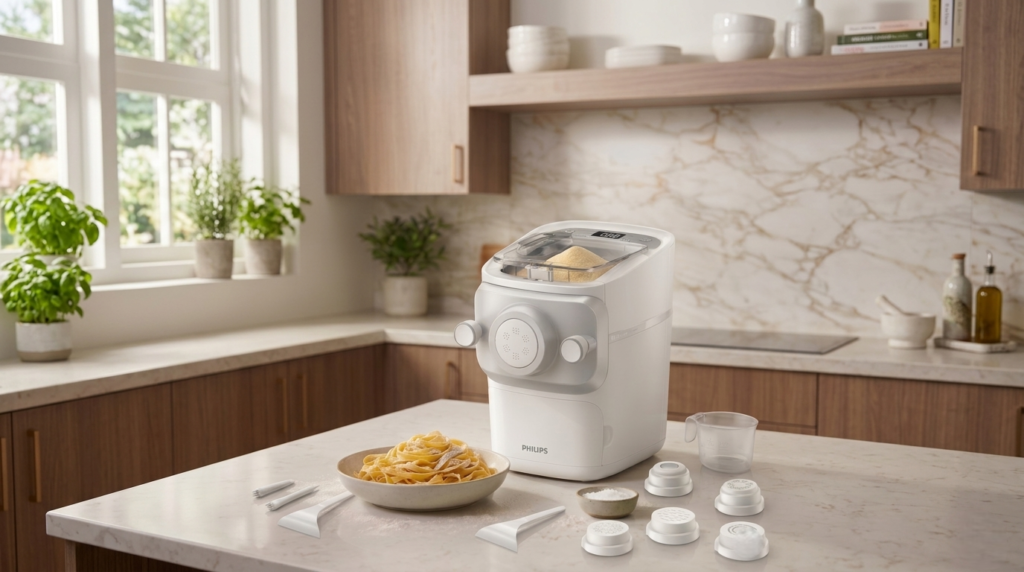
- 8 shaping discs included: spaghetti, fettuccine, penne, lasagna, angel hair, pappardelle, tagliatelle, and thick spaghetti — enough variety for most households
- Up to 8 portions per batch: makes it viable for a family dinner or weekly meal prep, not just a single serving
- Under 10 minutes from start to finish: roughly 3–4 minutes mixing, 4–5 minutes extruding
- Dishwasher-safe removable parts: all components that contact the dough detach for cleaning
- Flour flexibility: works with standard wheat flour, gluten-free alternatives (chickpea, lentil, lupin flour), and custom additions like eggs or herbs
- LED display with minimal controls: straightforward to operate without a manual
Practical Benefits You’ll Actually Notice
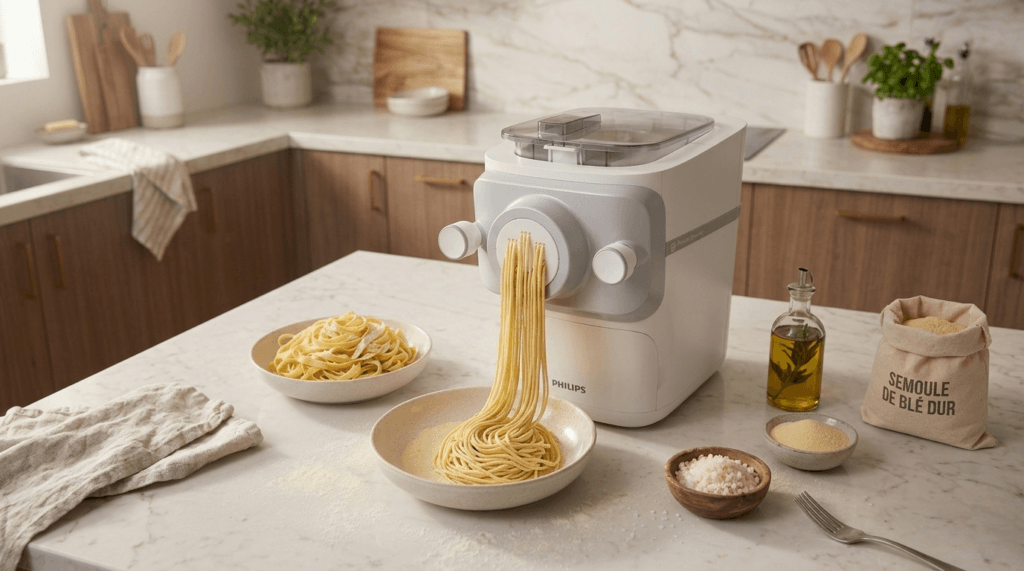
The clearest benefit is time. A full batch of 8 portions — enough to feed a family — takes less than 10 minutes from adding ingredients to having pasta ready to cook. That makes fresh pasta a realistic weeknight option, not just a weekend project.
A realistic scenario: You get home at 7pm. You pour flour and water into the machine, set your disc, and press start. By the time you’ve prepped garlic and sauce ingredients, the pasta is done extruding. You cook it for 2–3 minutes in boiling water. Dinner is on the table with fresh pasta — in about 30 minutes total.
The flour flexibility adds real value for households with dietary needs. Substituting lentil or lupin flour can reduce carbohydrates by up to 80% compared to standard wheat pasta, according to Philips’ own comparisons. The machine handles these doughs without requiring technique adjustments.
The mixing quality is also genuinely better than hand-mixing for most people. The metal paddle and optimized chamber produce a consistently well-blended dough that results in pasta with better elasticity and bite than what most home cooks achieve manually.
What Customer Feedback Tends to Highlight
Available feedback on this model generally appreciates the speed and the ease of use — particularly for people who had never made pasta before. The no-fuss automation is consistently mentioned as the standout feature.
Among more recurring reservations: the power cord is short (around 0.8m), which limits placement flexibility. The machine is also bulky, which matters if counter or storage space is limited. A few users note that gluten-free doughs require some experimentation to get the hydration ratio right before results are consistent.
Overall usage sentiment leans positive among buyers who eat pasta regularly and were looking for a practical, repeatable solution rather than a manual craft experience.
Strengths and Limitations: An Honest Overview
What works well:
- Fully automated — no skill or experience required
- Consistent dough quality thanks to ProExtrude and Perfect Mixing Technology
- 8 discs provide good shape variety without buying accessories
- Large batch capacity makes it practical for families
- Dishwasher-safe parts simplify cleanup
- Supports dietary customization (gluten-free, low-carb, egg pasta)
What to factor in:
- Short power cord (~0.8m) — placement near an outlet is essential
- Bulky footprint — not ideal for small kitchens with limited counter or cabinet space
- Price sits in the mid-to-premium range for electric pasta makers
- Gluten-free doughs may need a few trial runs to dial in hydration
- No manual extrusion control — you’re working with the machine’s automated cycle
Is This Pasta Maker Right for You?
This product is relevant if you eat pasta regularly, want fresh pasta to be a realistic weeknight option, and prefer a hands-off automated process over a manual craft approach.
It will be especially suited to families cooking for multiple people, anyone with gluten or carb sensitivities who wants to control ingredients, and beginner home cooks who want good results without a learning curve.
It will be less suitable if you cook for one or two people infrequently (the batch size may feel wasteful), have very limited counter space, or prefer the tactile, hands-on experience of traditional pasta making.
Final Verdict
The Philips 7000 Series Pasta Maker (HR2660/03) does what it promises: it removes the skill barrier and the time cost from fresh pasta. The ProExtrude technology produces noticeably better dough consistency than hand-mixing for most users, the 8 included discs cover the shapes most people actually cook, and the cleanup is genuinely simple.
It’s not cheap, and it’s not small. But for anyone who eats pasta regularly and wants fresh pasta to feel effortless rather than occasional, it’s a machine that earns its place in the kitchen.