
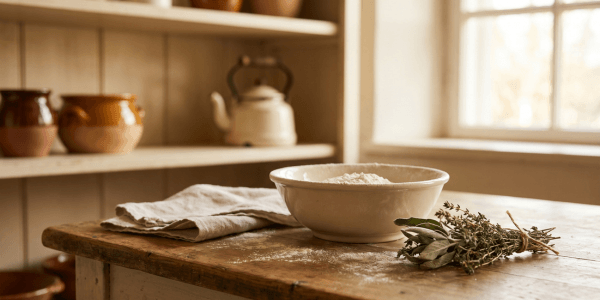
There’s a particular kind of knowledge that never made it into any cookbook. It lived in the angle of a wrist over a pot, in the pause before the salt was added, in the way a kitchen could smell like home before you even reached the door. We’ve been thinking about that knowledge a lot lately — the kind passed not through pages but through presence. And we think it deserves a moment of quiet attention.
The Kitchen That Never Needed a Timer
Walk into any grandmother’s kitchen at the right hour and you feel it before you understand it. A low warmth rises from the stove. Something — broth, perhaps, or something sweeter — has been going since morning. The light falls differently here, filtered through curtains that have absorbed ten thousand meals.
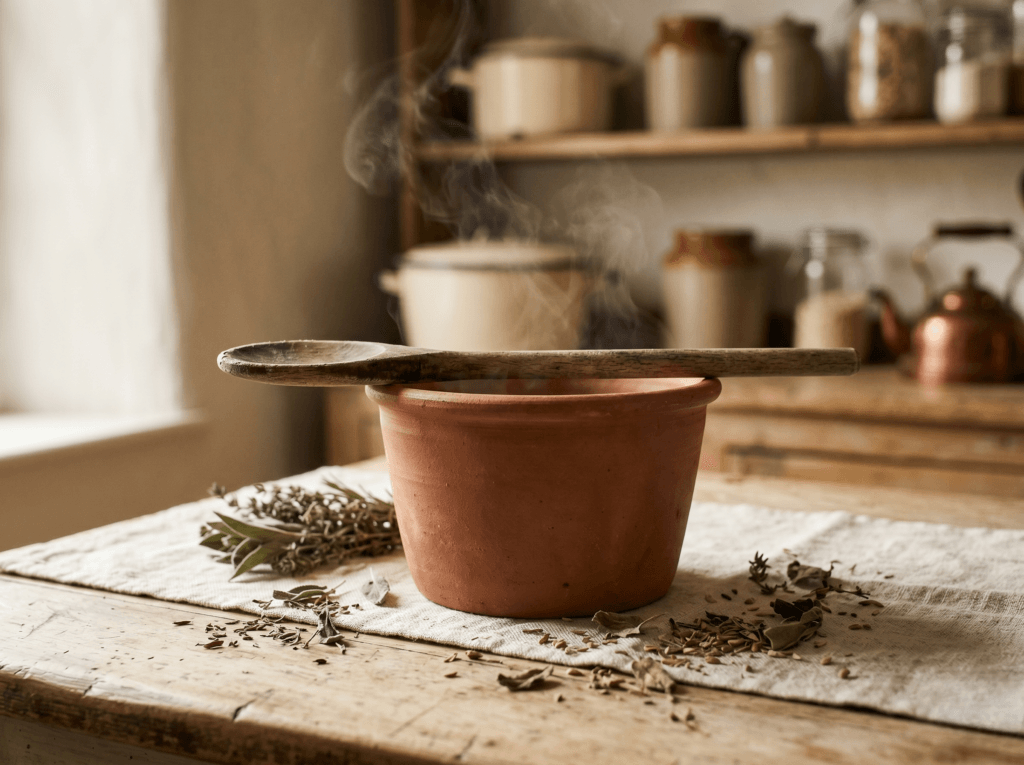
We’ve noticed that these kitchens share a particular quality: they feel inhabited. Not cluttered, not staged — just genuinely lived in by someone who spent decades in conversation with a stovetop. The wooden spoon resting on the counter isn’t a prop. It’s a tool that has learned the weight of a hand.
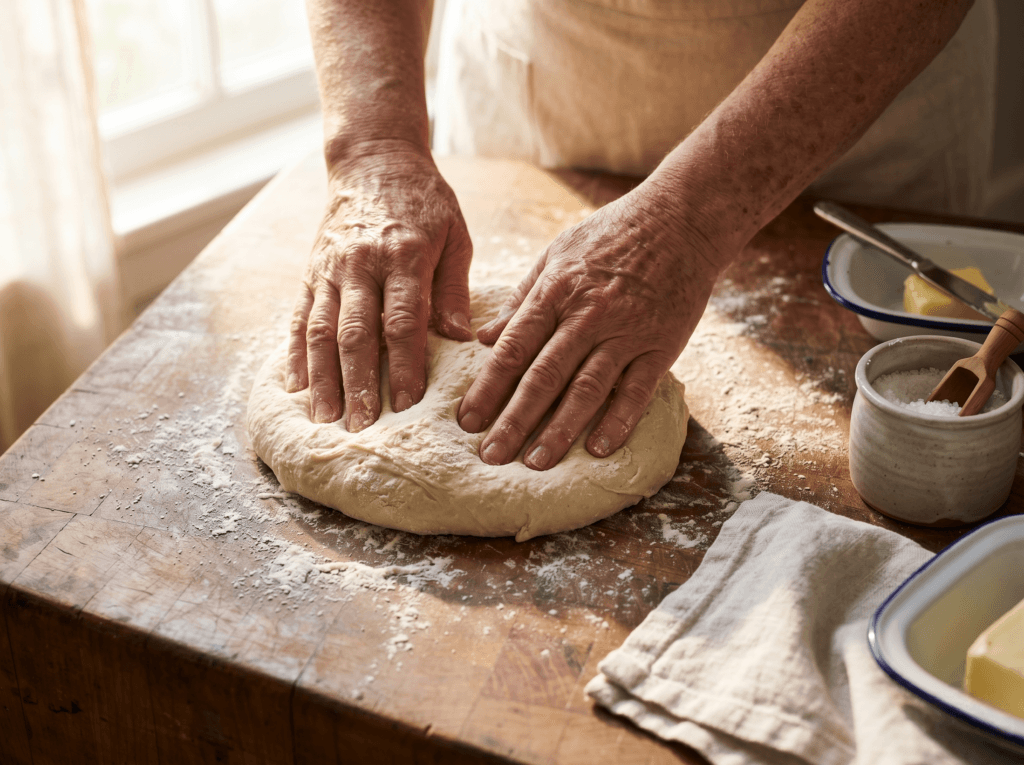
This kind of cooking doesn’t announce itself. It doesn’t photograph well in the making. It happens in the periphery — a slow turn of the wrist, a thumb pressed into dough to test its readiness, a taste taken directly from a ladle without ceremony. The kitchen, in these hands, becomes a place of quiet fluency.
The best kitchens are the ones that have been broken in slowly — where the rhythms of cooking have worn grooves into the countertop and the shelves.
What strikes us most isn’t any single technique. It’s the unhurried confidence. The absence of anxiety. The deep, almost physical certainty that things will be fine, because they always have been.
The Small Rituals That Carried Everything
Here’s the thing about inherited cooking: it travels in gestures, not in words. The particular way a sauce is stirred in a figure eight. The insistence on tasting three times before adjusting. The habit of saving the last bit of cooking fat in a small ceramic jar near the stove — not from frugality alone, but from a refusal to let anything go to waste.
These aren’t quirks. They are compressed philosophy. Each small ritual is a sentence in a language that was never formally taught. A grandmother who always added a bay leaf to the stock wasn’t following a written rule — she was following her own mother’s hand, and her mother’s before that.
We find ourselves reaching back for these moments often. A pinch added without measuring. A pot covered halfway, not all the way. A crust left to rest under a cloth while something else is prepared. None of these things appear in the index of any cookbook. All of them make an enormous difference.
Worth noting: this kind of wisdom tends to disappear quietly. Not in one dramatic moment — but slowly, when there are no longer enough afternoons spent standing beside someone in a warm kitchen, watching.
Inherited cooking is less about memorizing a recipe and more about learning how to read a kitchen — its sounds, its smells, the way steam behaves on a cold morning.
The rituals that carried everything weren’t grand. They were just consistent. Done every time, without explanation, until one day someone leaned in close enough to understand why.
Why It Still Matters — Deeply
There’s a modern tendency to want cooking to be optimized. Faster, leaner, streamlined. And we understand the impulse — life is genuinely busy. But something gets lost when we reduce cooking to pure efficiency, and we think grandmother’s kitchen is the best argument against that reduction.
What that kitchen offered wasn’t just nutrition. It was orientation. A sense of being located in time and family and place. The smell of something slow-cooking on a weekday afternoon is a signal to the body: you are somewhere. Someone is here.
That kind of cooking is, in its own way, a cultural act. A steady, daily renewal of connection — to people, to seasons, to a particular way of understanding what a meal is for. It doesn’t require rare ingredients or professional technique. It requires patience, presence, and a willingness to believe that the ordinary act of feeding people is worth doing slowly. We think about this when we’re rushing. When we’re tempted to skip the step that takes the longest. There’s a small voice — and we suspect many of you have heard it too — that sounds suspiciously like someone older and calmer saying: give it more time.
An Invitation Back to Your Own Kitchen
You don’t need a grandmother’s kitchen to carry this forward. You need something smaller and more personal: a willingness to slow down once in a while, and pay attention.
Pick one dish you half-remember. Something eaten as a child, or described once by a parent. Don’t look for an exact recipe. Instead, try to recall the smell first — warm, herbal, sweet, smoky? Let that memory anchor you. Then build toward it.
You won’t get it right the first time. That’s not the point. The point is the attempt, the attention, the quiet conversation between what you remember and what you’re making now. Something in that process tends to open up — a patience, a curiosity, a pleasure that doesn’t have anything to do with producing a perfect result.
The goal isn’t to replicate the past. It’s to carry something of it forward, in your own hands.
We’ve found that the most satisfying meals we make aren’t the most ambitious ones. They’re the ones where we stopped checking the clock, let something reduce longer than we planned, tasted more than we thought necessary. Grandmother’s kitchen isn’t a place. It’s a posture. And it’s available to anyone who’s willing to stand still for a moment.
Frequently Asked Questions
Why does food made in a grandmother’s kitchen often taste different from the same recipe made elsewhere? Much of it comes down to accumulated practice and patience. Grandmothers who spent decades cooking the same dishes developed intuition that can’t be fully captured in a written recipe — knowing when a sauce is ready by its sound, or when bread dough has had enough by its texture. That deep familiarity with a dish, rather than any secret ingredient, is often what makes the difference.
How can I recreate traditional family recipes if nothing was ever written down? Start with sensory memory — smell, texture, color — rather than ingredient lists. Ask family members to describe what they remember eating, not just what went into it. Then cook toward that memory, adjusting as you go. Many cooks who grew up in strong food traditions find that the act of making a dish repeatedly, rather than consulting a recipe, is what eventually brings them close to the original.
What kitchen wisdom from grandmothers is worth reviving in everyday American home cooking? A few things stand out: cooking with full attention rather than multitasking, tasting throughout the process rather than only at the end, letting things take the time they need (stocks, braises, doughs), and wasting as little as possible by finding uses for scraps, bones, and stems. These habits aren’t nostalgic tricks — they genuinely improve results.
Is heritage cooking relevant if my family doesn’t have a strong culinary tradition? Absolutely. Heritage cooking doesn’t require a specific cultural background. It’s really about the practice of cooking with intention and passing something of that on — whether through family recipes, regional ingredients, or simply the habit of making meals from scratch. Anyone can begin building that kind of kitchen culture, regardless of where they start.
How do I preserve kitchen wisdom before it disappears from my own family? The most effective method isn’t writing recipes — it’s cooking together. Spend an afternoon in the kitchen with an older family member, even if you’re not making anything in particular. Observe the small choices: what gets added when, how things are tasted, which shortcuts are never taken. Notes taken after the fact, in your own words, capture texture that formal recipes often flatten.
A Small Closing Thought
We started thinking about this piece because of a particular afternoon — the kind where the light comes in low and something is cooking and for a moment you feel entirely, unexpectedly at home. Those moments are rare enough to be worth protecting.
Grandmother’s kitchen was never really about any one dish. It was about the daily, unhurried act of making nourishment for people you love, without needing it to be anything more than that. There’s a kind of intelligence in that simplicity that we find harder and harder to come by, and worth every quiet effort to keep alive.
We hope something here stirred a memory. And if it did — go make it.
— Curated with care, Jad & Cyprien