
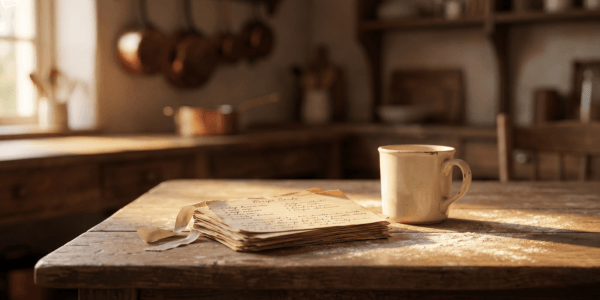
There’s a particular kind of quiet that settles over a kitchen table when an old recipe box gets opened. The cards are soft at the edges, some stained with butter or vanilla, and the handwriting changes from card to card — looping cursive, hurried block letters, a child’s careful copy of a grandmother’s hand. We’ve spent more time than we’d like to admit just sitting with these pages, not cooking from them, just reading them.
Handwritten cookbooks aren’t really about food. Not entirely. They’re about the people who stood at stoves before us, and the strange intimacy of seeing someone’s handwriting age across decades of the same dish.
The Opening Atmosphere — A Page Worn Soft
There’s something about the texture of a well-used recipe card that photographs and printed cookbooks simply can’t replicate. The corners go soft. The ink fades unevenly, darker where a thumb rested while stirring.
We’ve noticed that the most-loved recipes are often the messiest — smudged, annotated, sometimes with a second or third hand chiming in over the years. “Add more cinnamon” scrawled by someone’s daughter, decades after the original was written.
There’s a quiet honesty in that. A printed recipe tells you what to do. A handwritten one tells you what actually happened — the substitutions, the corrections, the small rebellions against the original instructions.
Morning light through a kitchen window seems to suit these pages best. There’s a softness to it that matches the paper itself, worn thin from being held by buttery fingers, year after year.
A Small Ritual — Reading Before Cooking
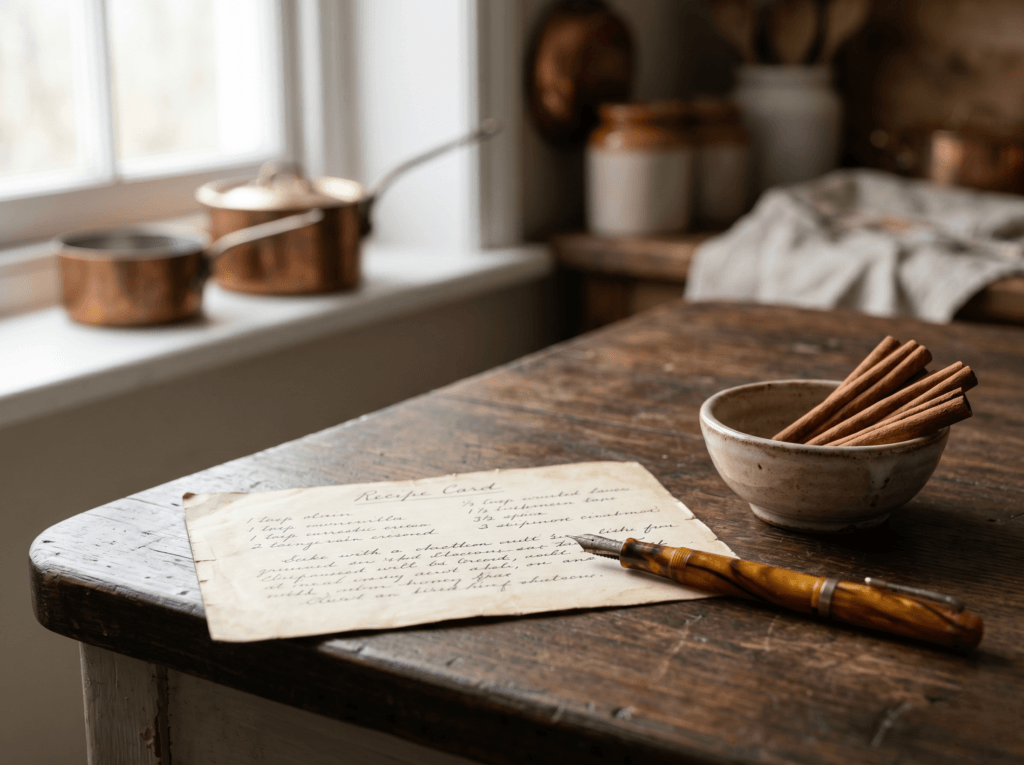
Before we even think about turning on the oven, we like to sit with a handwritten recipe for a few minutes. Just reading it. Noticing the handwriting, the abbreviations, the little asides written in the margins.
Sometimes there’s a note that has nothing to do with the recipe at all — a phone number, a name, a date circled for no reason anyone remembers. These details feel almost accidental, like finding a photograph tucked inside a book you didn’t know was there.
We think this slow reading matters. It’s a small ritual, but it changes how the cooking feels afterward — less like following instructions, more like continuing a conversation that started long before we arrived.
There’s also something grounding about ingredient lists written in a different era’s shorthand. “A handful of,” “until it looks right,” “as needed” — measurements that assume a kind of inherited knowledge, passed down through watching rather than reading.
It makes us slow down. And these days, slowing down in the kitchen feels like its own kind of gift.
Why It Matters — Recipes as Quiet Archives
Here’s the thing about handwritten recipes: they’re often the only written record of a person that exists in their own hand. Letters get lost. Diaries feel too private to keep. But a recipe card, tucked in a box in the back of a drawer, survives.
We’ve heard from people who’ve told us that holding a grandparent’s handwriting — even just a list of ingredients — felt more personal than looking at old photographs. There’s something about handwriting that carries a person’s rhythm, their hesitations, the particular way they crossed a “t” or looped an “l.”
Family recipes also tend to shift slightly with each generation, even when no one means for them to. A pinch becomes a teaspoon. An ingredient gets swapped for what was available at the time. These small changes, layered over decades, become their own kind of history — unspoken, but legible if you know how to read it.
It’s worth noting that these aren’t just sentimental objects. They’re documents of how families moved, adapted, and made do — what was scarce, what was abundant, what mattered enough to write down and keep.
An Invitation — Looking Through Your Own Kitchen
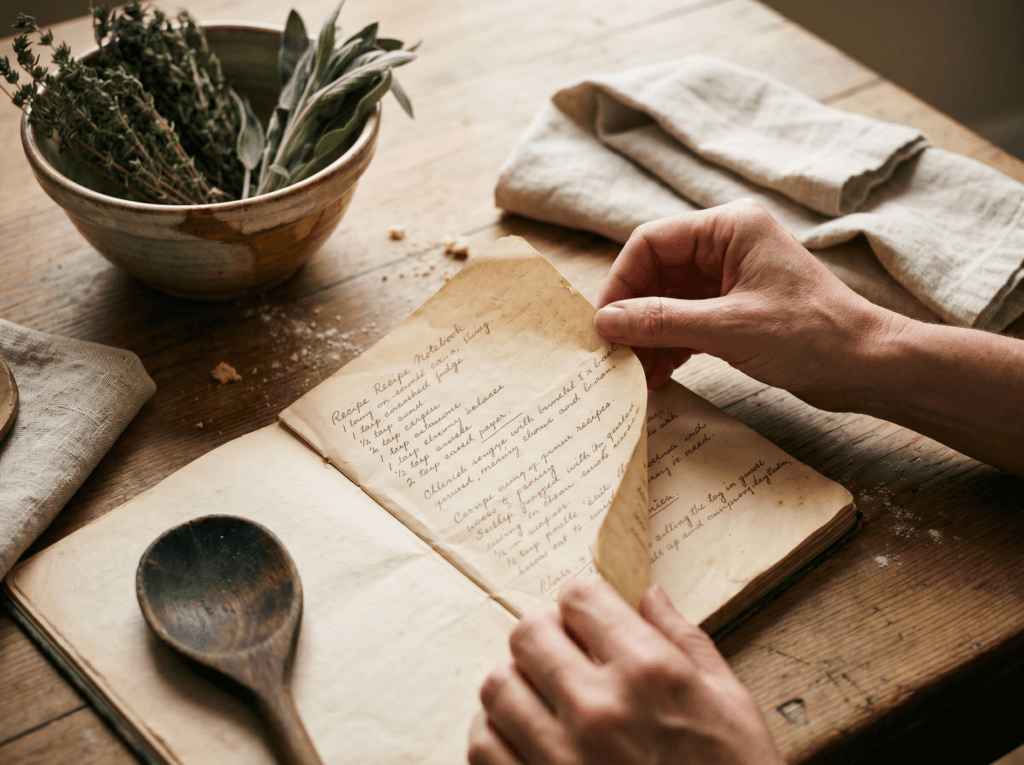
If you’ve got a recipe box, a folder of clippings, or even a single card tucked into a cookbook somewhere, it might be worth pulling it out. Not to cook from, necessarily — just to look.
Notice the handwriting. Notice what’s missing, what’s been crossed out, what’s been added in a different pen years later. These details tell their own quiet story, even if no one’s around anymore to explain them.
We’d gently suggest not rushing to digitize or “preserve” everything right away. There’s value in just sitting with these pages first, in their imperfect, lived-in state. The smudges are part of the story too.
And if you don’t have anything like this in your own family — maybe it’s worth starting one. A card, a notebook, your own handwriting on a recipe you love. Someone, someday, might sit with it the way we sit with these old ones.
Frequently Asked Questions
Why do handwritten family recipes feel more meaningful than printed ones? Handwriting carries personal details — pace, habit, even mood — that printed text doesn’t. It feels like a direct trace of the person who wrote it.
What can old recipe cards tell us about family history? Beyond the dish itself, they often reveal ingredient availability, regional influences, and how recipes were adapted across generations.
Is it okay to cook from a handwritten recipe that’s hard to read? Absolutely — and the guesswork involved can become part of the experience, connecting you to how the original cook likely approached it too.
How should handwritten recipes be stored to keep them readable? Keeping them away from direct sunlight and excess moisture, and handling them gently, helps preserve both the paper and the ink over time.
Do handwritten cookbooks have to be old to feel meaningful? Not at all. A recipe written today, in your own hand, can become just as meaningful to someone decades from now.
A Small Closing Thought
We don’t think handwritten recipes need to be rare or perfectly preserved to matter. Sometimes it’s enough that they exist at all — a little proof that someone, once, stood in a kitchen and wrote something down so it wouldn’t be forgotten.
There’s a kind of comfort in that continuity. Recipes get passed along, changed, misread, rewritten — and somehow, the dish survives anyway.
Maybe that’s the real language of recipes. Not the instructions themselves, but everything written around them.
— Curated with care, Jad & Cyprien