

The kettle exhales, and the little black cone is already waiting over the cup. Water meets grounds; the bed swells and sighs. In a city apartment where the day usually starts at a sprint, this is the one minute nobody rushes — the pour-over coffee dripper ritual, thirty seconds of spiraling water and the smell of something patient.
The cone doesn’t ask for much. A filter, a slow hand, a person willing to stand still. In return it gives the first honest quiet of the morning, dripping steadily into the dark below while the radiator ticks and the street outside is still deciding what kind of day it wants to be.
Where the Spiral Rib Coffee Dripper Comes From
Pour-over brewing is an old idea made new by patience. Paper filtration entered home kitchens in the early 1900s, a German invention born from a simple wish: coffee without the grit. The conical form came later, refined in Japan, where a century-old tradition of glasswork and heatproof craft turned the humble funnel into something considered.
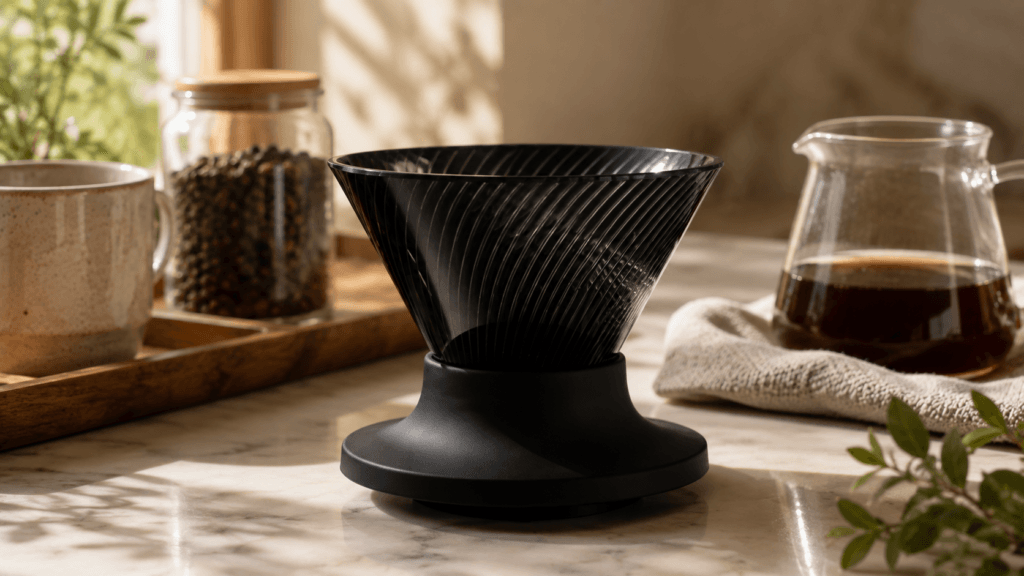
The signature details of its kind — a single wide opening at the base, ribs spiraling up the inner wall — weren’t decoration. They let the paper breathe away from the cone, let air escape upward, let the brewer decide the pace instead of the tool.
For decades these cones lived in ceramic and glass. Then came resin — light, warm to the touch, unbothered by a knock against the sink. It’s the version that travels from Tokyo workshops to fire escapes in Brooklyn and galley kitchens in Chicago without ceremony, and somehow without losing any of the original’s quiet intent.
What Makes the Resin Pour-Over Cone What It Is
Pick it up and the first surprise is how little it weighs. It feels almost provisional — until you use it, and realize the lightness is the point. This is a tool designed to disappear into the gesture. Matte black, warm-skinned, it takes fingerprints and steam and gives back nothing but coffee.
People misread its kind constantly. They assume the cone does the brewing. It doesn’t. It holds the conditions — the angle, the airflow, the open path downward — and hands every other decision back to you. That’s not a flaw; that’s its character. It’s the rare kitchen object that makes you better instead of making itself indispensable.
What you notice, living with one:
The ribs: fine spiraling ridges you feel under a fingertip, keeping the wet paper from sealing against the wall.
The single opening: wide and unapologetic, so the water moves at your speed, not the cone’s.
The warmth of resin: it never bites cold the way ceramic does on a February morning.
The sound: a soft, uneven percolation, like rain finding its way off a roof.
The honesty: pour carelessly and it will tell you, cup after cup, until you slow down.
Living With It, One Week at a Time
One day, he was making coffee in near darkness, before his 7:40 a.m. train, with only the light from the range hood to guide him. The other day, he moved closer to the kettle, just as useful objects tend to drift toward the center of the countertop. Later comes his big moment: two cups brewed in quick succession, the second one for someone who, still in a bathrobe, is reading on the couch with one leg tucked under him.
Care is barely a task. A rinse under warm water, a moment upside down on the rack, the occasional swipe of a soft cloth along the ribs where oils like to settle. A cone well loved shows it quietly — a faint sheen inside the spiral, a matte softness at the rim where hands have found it a thousand times. It never demands maintenance; it simply rewards attention, which is a different thing entirely.
The strange part is what happens to the person. The cone imposes nothing, yet mornings bend around it. You start heating water before checking your phone. You stand still for the bloom. The ritual this piece quietly serves has its own story in The Discipline of Slow Kitchen Mornings.
The Quiet Companionship
There is a particular loyalty owed to objects that meet us before we are quite ourselves. The cone sees us unshowered, unresolved, half-argued-with. It never once holds it against us. Keep the same one for years and it stops being equipment; it becomes a witness — the shape your hand reaches for without looking, the fixed point in mornings that otherwise refuse to repeat.
And this fidelity is not local. The same small ceremony unfolds wherever English is muttered over a first cup — a drizzly flat above a London bus route, a bright kitchen bench in Melbourne before the heat arrives — one cone, one person, one held breath while the water falls. The companionship translates everywhere, because tiredness and hope at 7 a.m. need no translation at all.
Caring for a Coffee Dripper, Gently
Rinse it warm, right after brewing, because coffee oils set as they cool and dull the cup that follows.
Skip the harsh scrubbers; resin keeps its soft finish for years when a cloth does the work a scouring pad would ruin.
Wet the paper filter before the grounds go in, so the first taste of the morning is coffee, not paper.
Let it dry open on the rack, since trapped moisture is the only enemy a cone this simple really has.
Pour in slow circles from the center outward, because the spiral inside was drawn for exactly that motion.
One object is a beginning, not a map. The wider geography of these unhurried starts — the table, the light, the whole slow hour — is drawn in Breakfast Bliss Guide for Calm, Slow Mornings: A Calm Map of Slow Mornings, where this little cone is just one resident among many.
And if the cup deserves company that keeps it warm as long as the morning lasts, there’s a small edit waiting in Heated Coffee Mugs for Slow Breakfast.
We’ll admit something: we almost didn’t respect ours at first. It felt too light, too plastic-adjacent, too easy — we kept it behind the ceramic one like an understudy. Then the ceramic chipped, the understudy went on, and three years later it’s the one we’d grab in a fire drill. Affection for objects rarely arrives on schedule. Sometimes it just accumulates, one quiet pour at a time, until you notice it’s already there.
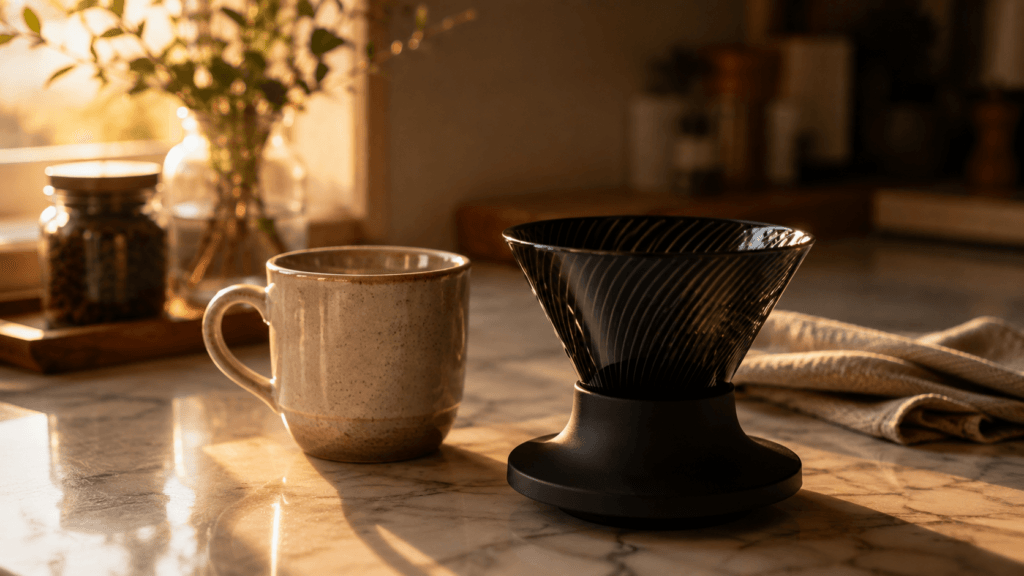
The coffee is finished long before the day is, but the cone stays — rinsed, upturned, patient on the rack while meetings happen and trains run late. Some objects shout their way into a home. This one earned its place the slow way: one morning at a time, one unhurried cup, until the counter felt incomplete without it. That’s the only test that matters, and it can’t be rushed.
Jad & Cyprien