
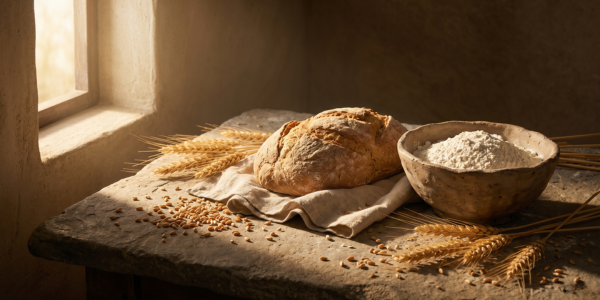
Before language, before currency, before borders — there was bread. The oldest leavened loaves date back over fourteen thousand years, yet something in the smell of a crust browning in an oven still reaches us at the same depth. Bread as a cultural symbol is not a metaphor invented by scholars. It is a lived truth, baked into the daily rituals of every civilization on earth. This is the story of how a simple union of grain, water, and heat became the most meaningful object in human history — and what it asks of us each time we break it.
A History Written in Grain: Bread Across Civilizations
The earliest evidence of deliberate bread-making was discovered in Jordan, at a site called Shubayqa 1: flatbreads baked by Natufian hunter-gatherers some 14,400 years ago — four millennia before agriculture itself became systematic. This detail alone overturns the comfortable assumption that bread followed farming. In some ways, the desire for bread may have preceded it.
Ancient Egypt elevated bread to theology. Loaves were placed in tombs as sustenance for the afterlife, and the Egyptian word for bread, aish, is also the word for life. The Roman Empire industrialized its production — Rome’s grain supply was a matter of political survival, and its collapse was as much a bread crisis as a military one. In medieval Europe, the division between white bread for the wealthy and dark rye for the poor crystallized an entire social hierarchy in flour.
Each culture left its trace in the loaf: the fluffy injera of Ethiopia fermented over days and used as both plate and utensil; the thin, crackling matzo of Jewish tradition, a bread shaped by urgency and memory; the sourdough of San Francisco, whose wild yeast carries the living signature of a specific geography. The history of bread is, at its core, the history of bread traditions and culture — of what a people grew, traded, believed, and shared.
What Bread Is Made Of: The Science Behind the Symbol
At its most elemental, bread requires three things: grain, water, and time. But each of these variables carries enormous complexity. The grain determines character — hard wheat produces the elastic, chewy crumb of a baguette; soft wheat yields the tender crumb of a brioche; ancient grains like emmer or einkorn bring nuttiness and density that modern varieties have largely lost. The water activates gluten, the protein network that gives bread its architecture.
Leavening is where the deepest transformation occurs. Wild fermentation — the slow, microbially rich process behind sourdough — is one of the oldest biotechnologies in human history. The bacteria and yeasts that colonize a starter reflect local flora; a Parisian levain and a San Francisco sourdough are genuinely different living cultures, shaped by geography and practice. Industrial yeast, introduced in the 19th century, standardized bread-making but traded complexity for convenience.
The most common mistakes in home baking come from impatience: under-fermented dough that lacks flavor, over-floured surfaces that dry the crumb, ovens that are not hot enough to create the initial oven spring. Understanding bread means understanding that living dough has its own rhythm, and that the baker’s role is to listen rather than impose.
- Fermentation time shapes flavor more than any single ingredient.
- Crust development requires high, dry heat — steam in the first minutes, then dry air.
- Salt is structural, not decorative: it strengthens gluten and controls fermentation speed.
- Shaping is not aesthetic — it builds internal tension that determines how bread rises.
Baking Bread at Home: How to Reconnect with the Gesture
Making bread at home is less about following a formula and more about developing a relationship with a living material. Begin with a simple country loaf: 450 g of strong white flour, 360 g of water, 9 g of salt, and either a tablespoon of active sourdough starter or 5 g of dry yeast. Mix until the flour is fully hydrated — this does not require kneading immediately. Let the shaggy mass rest for 30 minutes. What follows is the first transformation: the autolyse, where gluten begins forming on its own.
Over the next two to four hours, fold the dough gently every 30 minutes rather than kneading aggressively. Each fold builds strength without tearing the gluten web. You will feel the dough changing under your hands — from slack and sticky to smooth and elastic. When it holds its shape and bubbles appear beneath the surface, it is ready to shape.
Shape with decisive, clean movements: flatten gently, fold the edges toward the center, then turn the loaf seam-side down and drag it across an unfloured surface to build surface tension. Place in a floured banneton or lined bowl. Cold-prove overnight in the refrigerator. The next morning, preheat your oven to 250°C with a cast iron pot inside. Bake covered for 20 minutes to trap steam, then uncover for 25 minutes until the crust is deep amber. The visual, tactile, and aromatic signs of success are unmistakable: a hollow knock on the base, a crackling crust as it cools, and a crumb that is open but not gummy.
What the Loaf Carries
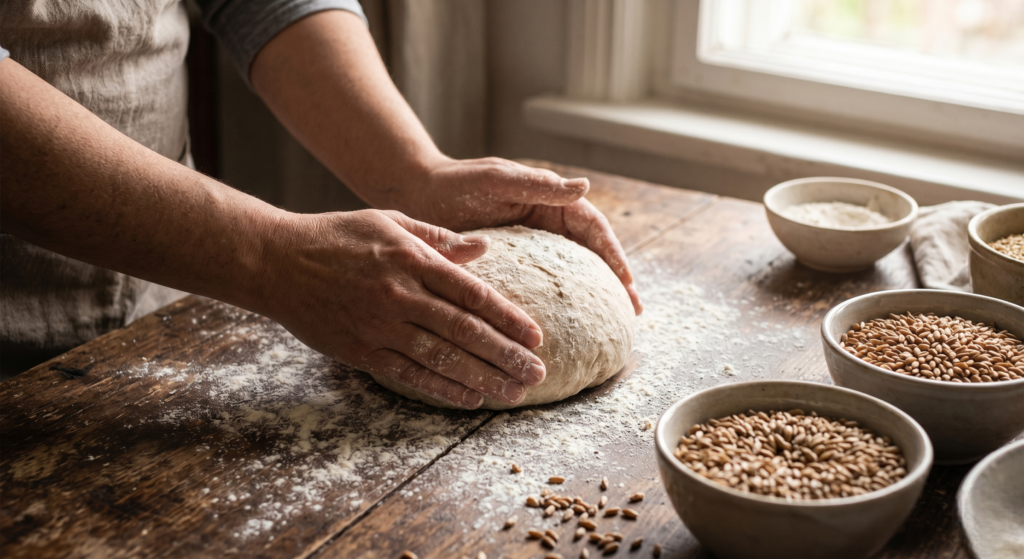
There is a moment, just before shaping, when the dough rests in your hands — warm, alive, slightly resistant. It is not quite obedient, not quite wild. Something passes between the baker and the bread in that pause that no recipe can account for.
There is a moment, just before shaping, when the dough rests in your hands — warm, alive, slightly resistant. It is not quite obedient, not quite wild. Something passes between the baker and the bread in that pause that no recipe can account for.
“Bread is older than metal. Bread is older than writing. A loaf of bread is the most fundamental human artifact.”
— Ursula K. Le Guin
The symbolic meaning of bread runs through almost every major ritual in human life — the communion wafer, the Shabbat challah, the wedding naan, the funeral bread of Greek Orthodox tradition. Not because bread was convenient, but because the act of making it — of transforming raw grain through labor, time, heat, and care — mirrors the deepest structure of human effort. We give time to something, and it becomes more than what it was.
In an age of instant gratification, the long fermentation of a sourdough is a quiet act of resistance. It insists on slowness. It rewards attention over speed. And in the smell of it — warm, faintly sour, deeply wholesome — is something we seem to recognize at a level older than memory.
Five Things That Will Change How You Bake Bread
First: weigh everything. Volume measurements are unreliable with flour — its density changes with humidity and how tightly it settles. A kitchen scale is the single most useful investment a home baker can make, because precision in hydration is the difference between a wet, open crumb and a dense brick.
Second: use cold water in summer, warm in winter. Dough temperature affects fermentation speed. Aim for a final dough temperature between 24°C and 26°C. On a hot day, cold water keeps wild yeast from overfermentation, which would flatten flavor and weaken structure.
Third: develop patience with the fridge. Cold overnight proofing is not just a scheduling convenience — it deepens flavor dramatically, slows fermentation to build complexity, and makes scoring far easier because the cold dough holds its shape under the blade.
Fourth: score with intention. The cuts you make before baking control where the bread opens and where steam escapes. A single, confident slash at a 30-degree angle produces the classic ear. Multiple shallow cuts create a more even bloom. Hesitant cuts produce torn, irregular results.
Fifth: let it cool fully before cutting. At least one hour for a small loaf, two for a large one. The crumb continues setting as the steam inside redistributes. Cutting too early compresses the structure and makes the interior gummy — patience here is not optional.
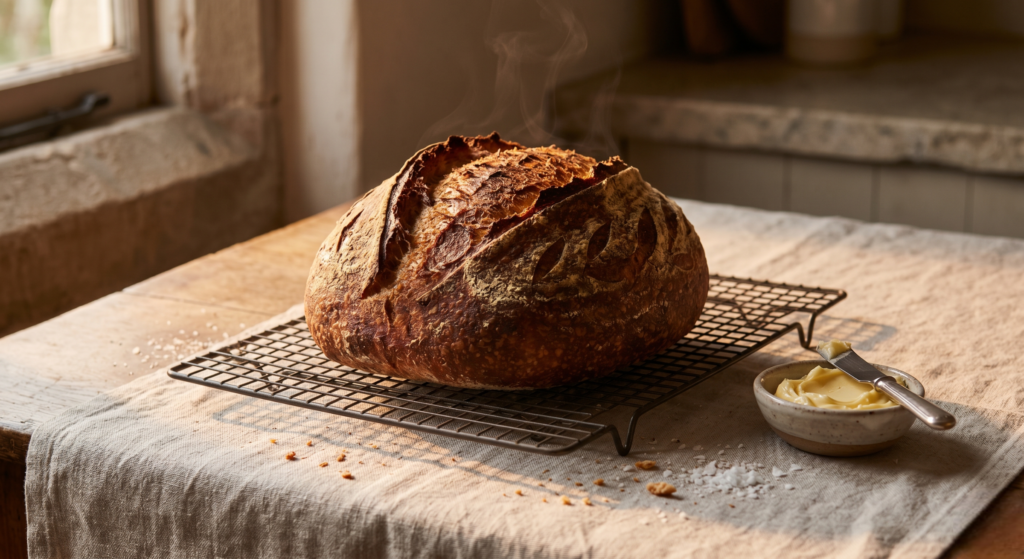
Bread asks nothing of us except our attention. It does not perform. It does not promise. It simply takes what we offer — grain, water, time, the warmth of an oven — and gives back something that has nourished humanity for longer than any culture has existed. Every loaf you make carries that weight, lightly.
Perhaps that is what bread, at its deepest, has always been: not a metaphor, but a practice. A way of placing our hands on something ancient and being, for a moment, part of a continuity far larger than ourselves.