
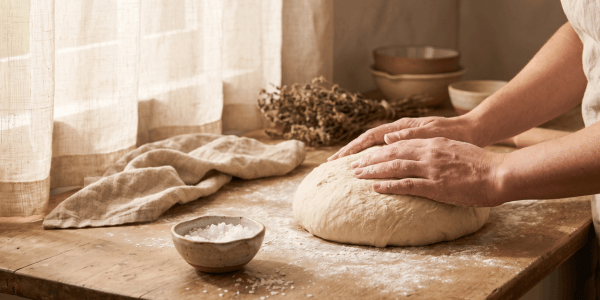
There is a particular silence that settles over a kitchen when someone is truly cooking — not rushing to feed, but choosing to make. The hands move slowly. Flour clouds the air. The smell of butter warming in a pan becomes, for a moment, the only thing in the world. Therapeutic cooking is not a trend invented by wellness culture. It is something older and more honest than that — something our grandmothers understood without naming it: that the act of making food has always been one of the quietest and most powerful ways to come back to yourself.
An Ancient Remedy: How Cooking Became Care for the Mind
Physicians in 18th-century Europe were already prescribing kitchen labor to patients they described as suffering from “nervous exhaustion.” In early American sanatoriums, bread-baking and kitchen work formed the backbone of structured recovery — a practice that would gradually evolve into what modern psychology calls occupational therapy. But long before clinical vocabulary existed, cultures across the world had already grasped this instinctively. In Japan, the meditative precision of preparing a bowl of dashi — four ingredients, near silence — was never merely technique.
Cooking for mental health is not a modern prescription. The kitchen has always been a place where time moves differently, where the urgency of the outside world softens against the warmth of a stovetop. What has changed is not the practice, but the awareness: we are beginning, again, to name what we have always felt.
Why Mindfulness in the Kitchen Works: What the Brain Already Knows
When you knead bread dough, something unexpected happens. The rhythmic, focused motion — the pressure of your palms, the elastic resistance, the sound of the dough pulling away from the board — activates a productive resting state in the brain strikingly similar to what occurs during meditation. Cooking engages multiple senses at once: touch, smell, sound, sight. This layered sensory presence pulls attention away from rumination and into the body, into the moment.
Psychologist Kelly Lambert’s research on effort-driven rewards found that using our hands to create tangible results — a loaf, a sauce, a carefully folded dumpling — triggers dopamine and serotonin production in ways that purely sedentary activities simply cannot replicate. The physical dimension of cooking connects the brain’s motor circuits to its reward system in a feedback loop that feels, quite genuinely, like relief.
A few principles worth understanding:
- Repetitive manual tasks — kneading, stirring, chopping — have measurable effects on cortisol reduction.
- The act of completing a recipe, however modest, satisfies a deep human need for visible, concrete accomplishment.
- The smell of food cooking is among the most powerful triggers of positive emotional memory.
- Sensory engagement interrupts the abstract, cycling quality of anxious thought.
Therapeutic cooking, at its most fundamental, is the brain finding a place to actually land.
Cook With Intention: Turning an Ordinary Recipe Into a Ritual
You don’t need a special recipe. You need an intention.
Start with something that requires your hands — bread dough, hand-rolled pasta, meatballs shaped one by one. Choose a task with a beginning, a middle, and a visible end. One of the most direct paths to stress relief through cooking is the act of committing fully to a process and seeing it through — no shortcut, no quick swap. The full, patient arc of it.
Set the phone aside before you begin. Not dramatically. Just aside. Let soft music play, or let the kitchen stay quiet. Begin to notice what you actually notice: the way dough resists before it finally yields, the particular exhale of onions hitting a hot pan, the moment a sauce shifts from thin and raw to something deep and round. These transitions are not incidental. They are the point.
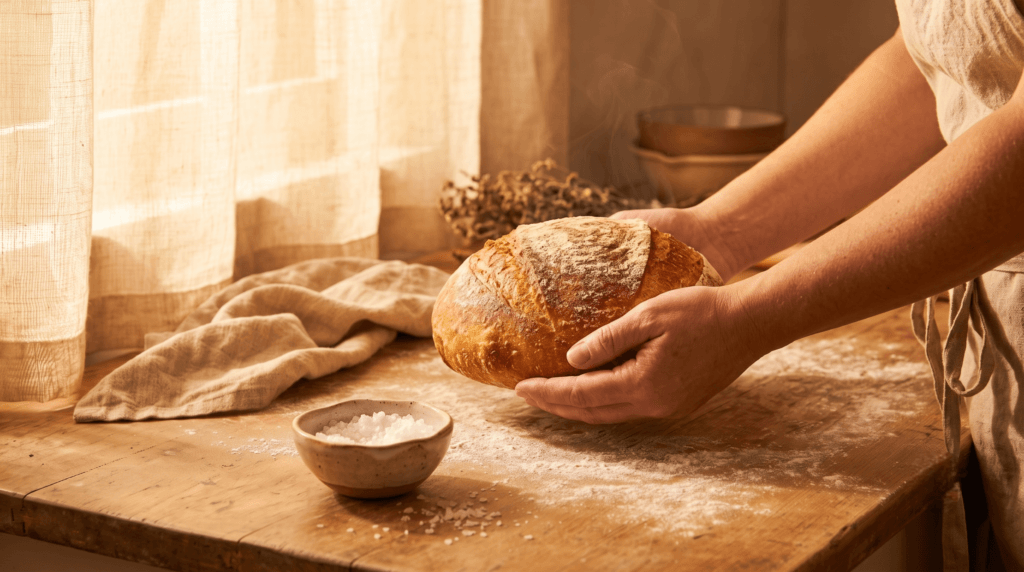
If you’re new to cooking with this quality of attention, try bread. Few preparations demand as much physical presence — the kneading, the patient wait, the watching for the rise. Bread teaches trust the way little else does in a kitchen. It fails when you rush it. It rewards when you let go.
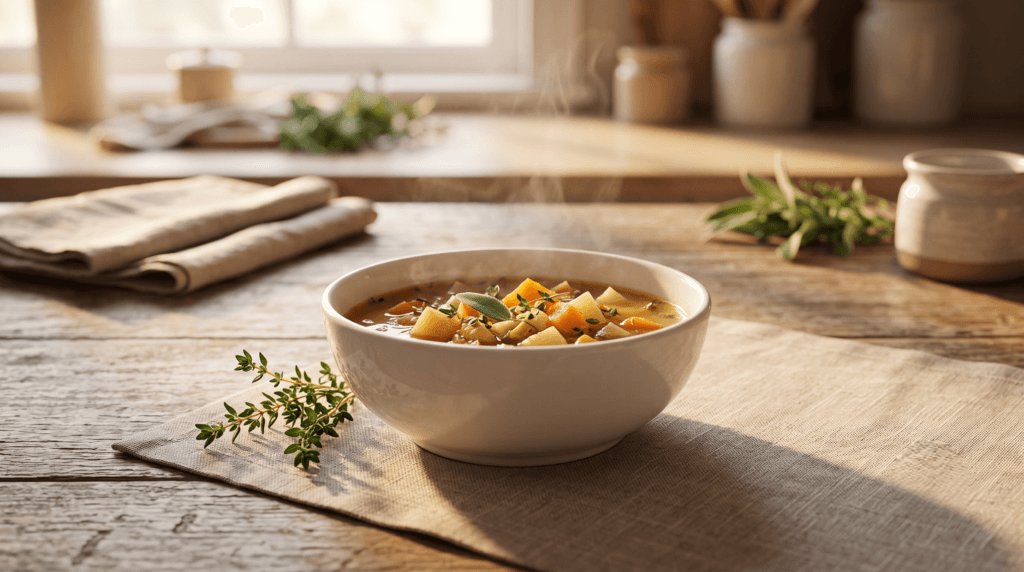
For those who find baking intimidating, a slow vegetable soup or a grain bowl stirred with care will do the same work. What matters is attention. What matters is showing up for the pot the way you would for yourself — with curiosity, not expectation.
The Quiet Alchemy of Flour and Time
There is a moment — if you let it come — when cooking stops being a task and becomes something closer to prayer. The kitchen grows quieter than the rest of the house. Time expands. You are not thinking about what you said this morning, or what you owe, or who you need to be tomorrow. You are simply here, hands in the dough, attention resting on warmth.
The French writer Colette once observed that the secret of good cooking is knowing how to wait. She was describing technique. She was also, clearly, describing something else.
The healing power of baking — of cooking anything slowly and with care — is that it gives the anxious mind a place to inhabit. Not distraction. Something more dignified than that. A task with texture, smell, weight, and a result that can be shared. In a culture that prizes speed and demands constant output, the act of standing at a stove for an hour, stirring something by hand, is quietly revolutionary. It says: this moment is enough. I am enough, just doing this.
Five Gentle Ways to Cook Your Way Back to Yourself
Choose manual over mechanical, when you can. Mashing potatoes by hand, grating cheese on a box grater, kneading without the stand mixer — these deliberate choices return you to your body. The slower method is often the more restorative one, not despite the effort, but because of it.
Cook what you actually love to eat. Therapeutic cooking only works when it’s honest. Make what makes you happy. Comfort food is allowed — it carries memory, and memory, as any good cook knows, is a form of nourishment too.
Begin with a mise en place ritual. Before the heat, prepare everything. Wash, chop, measure, arrange. Much of the peace lives here — in the quiet preparation before cooking even begins. It is an act of care toward your future self.
Let the mess exist. A flour smear on the counter, sauce on your sleeve — these are signs of presence, not failure. The kitchen that never looks lived-in rarely feels alive.
Cook something for someone else. Making food with another person in mind changes the texture of the act entirely. It shifts the attention outward, gently, and reminds us that cooking has always been an ancient, wordless form of love.
There was a winter when making soup on Sunday evenings became the ritual we hadn’t known we needed — not because the soup was remarkable, but because the act of it was. Peeling carrots. Watching stock slowly reduce. The quiet accumulation of small, purposeful gestures. By the time we sat down to eat, something had already shifted. The kitchen had done what it always does, when you let it: the table felt lighter. We did too.
What cooking gives us, at its most honest, is not just nourishment. It is the experience of making — of turning raw material into something whole, with your own hands, in your own time. In a world that often asks us to produce without pause, the kitchen offers a different contract: slow down, use your hands, pay attention. The result is not only edible. It is a kind of repair. Perhaps this is why, across every culture and every century, people have always returned to the fire — not merely to eat, but to remember, briefly, who they are.