
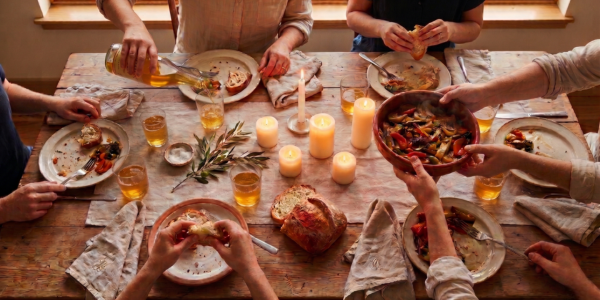
There is a particular silence that falls over a table just before everyone begins to eat — that suspended second when bread is being broken, glasses are still half-raised, and someone is laughing at something no one will remember tomorrow. It is in this small, almost invisible pause that something profound happens: shared meals build connections that no message, no call, no curated photograph can replace. Eating together is one of the oldest gestures of our species, older than writing, older than cities. To sit at the same table is to agree, even briefly, that we belong to each other.
A Brief History of Communal Dining
The history of communal dining is, in many ways, the history of civilization itself. Long before kitchens, before cutlery, before plates, our ancestors gathered around fire. Anthropologists like Richard Wrangham have argued that cooked food — and the act of sharing it — may have shaped the very architecture of our brains and our social bonds. The fire was the first table.
In ancient Greece, the symposium was as much a philosophical ritual as a meal. In Rome, the cena could last for hours, blending politics, poetry, and gossip. In rural France, the long Sunday lunch became a cultural institution; in Japan, the act of pouring tea for another guest was elevated to an art. From the Berber tagine eaten by hand to the Italian Sunday gravy simmering since dawn, every culture has invented its own way of saying the same thing: come, sit, you are welcome here. To share a meal has always meant more than to eat — it has meant to acknowledge another human being.
Why Sharing Meals Matters: The Quiet Architecture of Connection
We rarely think about it, yet the table is one of the most precise social instruments humanity has ever built. Why sharing meals matters is not sentimental — it is structural. Sociologists have repeatedly shown that families and communities who eat together regularly display stronger emotional resilience, better communication, and a deeper sense of belonging.
The reason is simple, and ancient. When we eat together, we synchronize. Our pace slows. Our voices soften. We breathe in the same room, between the same dishes. The act of passing a plate, of pouring water for someone before pouring our own, is a small, repeated lesson in attention.
The most common mistake is treating shared meals as a luxury reserved for celebrations. In truth, the meals that bind us most deeply are the ordinary ones — Tuesday soup, Saturday breakfast, the bowl of pasta after a hard day. What matters is not the menu. What matters is the table.
A few non-negotiable principles emerge across cultures:
Presence over perfection: a simple dish shared attentively beats an elaborate one eaten distractedly
No screens at the table: connection requires the full availability of the senses
One conversation, not many: eating together means listening together
Time, not speed: at least 30 minutes, ideally more
A beginning and an end: sitting down together, standing up together.
How to Cultivate the Art of the Shared Table
Cultivating shared meals is less about cooking skills than about rhythm. Begin by choosing one meal per week that will be protected — a sacred coordinate on the calendar that nothing routine is allowed to displace. Friday dinner. Sunday lunch. Wednesday breakfast. The day matters less than the consistency.
Prepare with intention, not pressure. Set the table before you start cooking — even a simple cloth, two candles, and matched glasses transform an ordinary kitchen counter into a place of meaning. Choose one dish you genuinely enjoy making, and let the rest be honest: bread from the bakery, fruit from the bowl, cheese from the fridge. Hospitality is not performance.
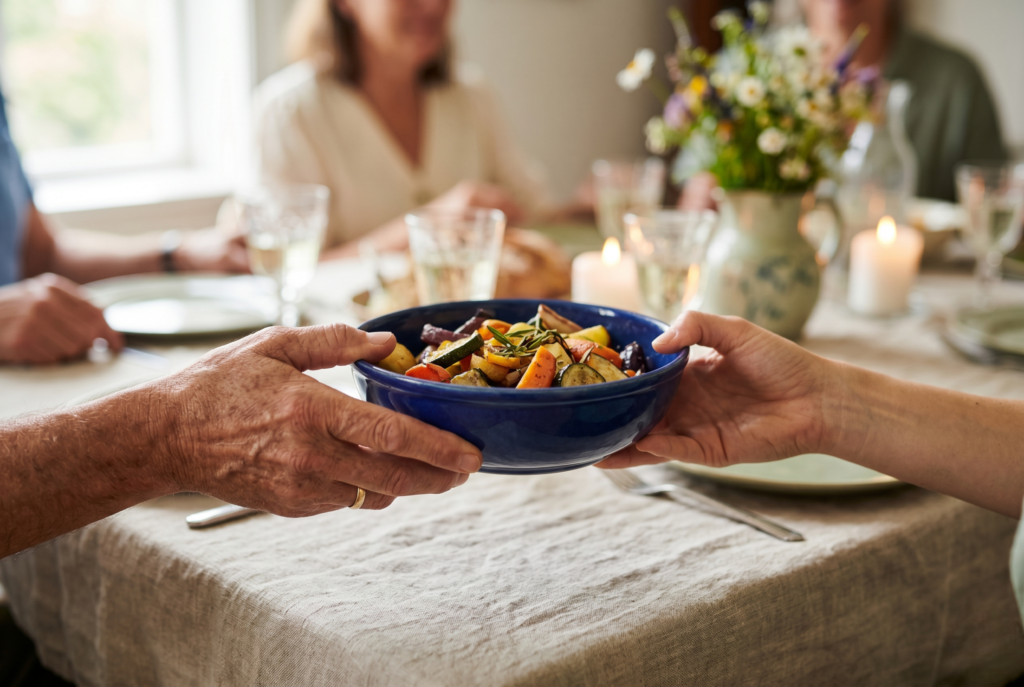
Pay attention to the small choreography. Serve from a central dish whenever possible, so that hands cross over the table — this single gesture is what transforms eating near others into eating with others. Pour drinks for the person beside you before yourself. Wait until everyone is served before lifting your fork.
Signs that the meal is succeeding are easy to recognize: laughter that surprises someone, a story told for the first time, a child quietly imitating an adult’s gesture, an unhurried second helping. When dessert arrives and no one has reached for their phone, you have built something rare. Keep building it.
The Quiet Magic of the Table
There is a kind of magic that happens at a shared table, and it has nothing to do with food. It is the moment a stranger laughs at your story and stops being a stranger. It is the way your grandmother’s recipe tastes different when she is the one serving it. It is the way bread, broken in half and offered, feels heavier than bread bought alone.
The Italian writer Carlo Petrini, founder of the Slow Food movement, once said: “To eat is an agricultural act, and to eat together is a cultural act.” The table is where the field meets the family, where the recipe meets the memory, where the day finally settles.
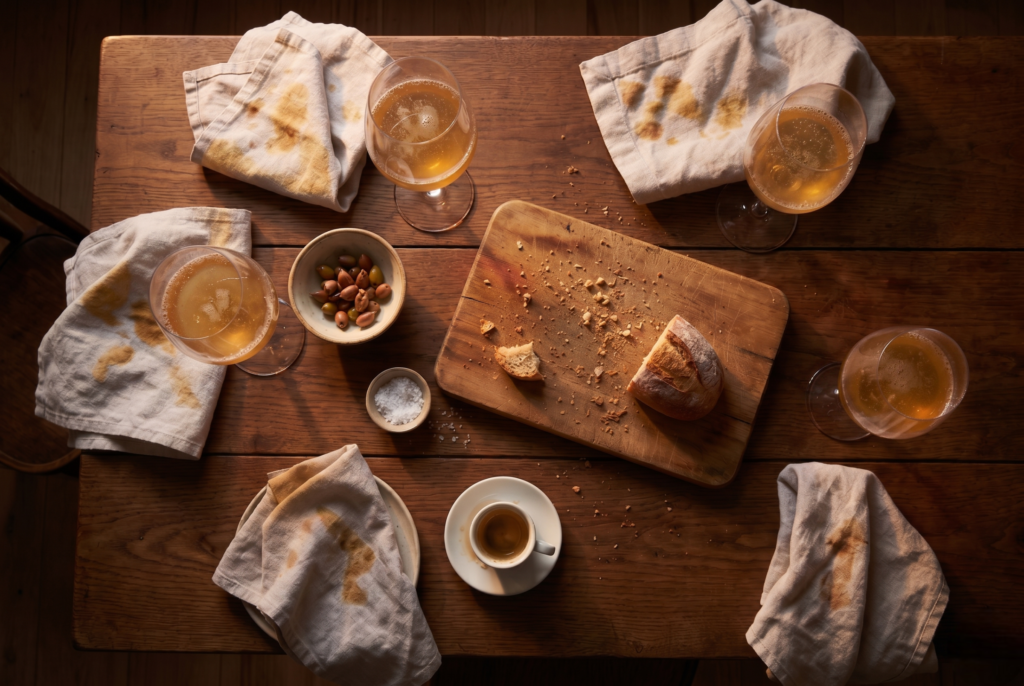
We do not always remember what we ate. We remember who poured the wine. We remember the silence between two courses, the joke that no one finished, the way the light moved across the wall. The meal ends. The connection stays.
Small Habits to Bring Shared Meals Back into Your Week
Restoring the practice of shared meals does not require a renovated kitchen or a free weekend. It requires small, repeatable habits — the kind that quietly reshape a household over months.
Anchor one meal per week as non-negotiable**, and protect it the way you would protect a meeting that matters. Repetition is what turns a meal into a ritual.
Cook one thing, buy the rest: making everything from scratch is the fastest way to abandon the practice. A roasted chicken, good bread, a green salad, a piece of fruit is already a feast when shared with attention.
Light something: a candle, a small lamp, anything that signals to the brain that this moment is different from the rest of the day. Lighting changes behavior more than menus do.
Ask one good question: not “how was your day,” but something specific: the best thing that happened, the strangest, the most surprising. Shared meals deepen with shared stories.
End the meal together: clear the table as a group, even briefly. The closing gesture matters as much as the opening one.
These habits adapt to every level of cooking experience and to every season. The kitchen does not have to be elaborate. The table only has to be honest.
Editorial Conclusion
A table is never just a table. It is a small republic of attention, renewed each time someone sits down. The dishes will be forgotten, the menu will fade, the recipes will be slightly altered next time. What remains is harder to name and impossible to replace: the rare, quiet certainty of having been, for an hour or two, fully present with someone else. Try lighting one candle this week. Set one place beside your own. The rest will follow.