
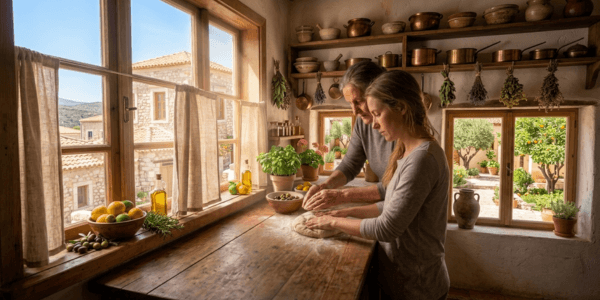
There is a particular kind of silence in a kitchen before anyone else wakes — the low murmur of the stove, the smell of fat warming in a cast-iron pan, a body moving through the space by memory alone. No recipe card in hand. No timer set. Just hands that have done this ten thousand times, carrying forward something they were taught before they could name it. Kitchen rituals passed down are not simply methods. They are a form of love made tangible, a language spoken in steam and salt and heat. This is the quiet inheritance most of us carry — and rarely stop to examine.
Where the Ritual Begins: The Deep Roots of Generational Cooking Traditions
Every culture on earth has its kitchen liturgy. In Morocco, the slow, counter-clockwise stirring of harira. In Japan, the precise folding of gyoza pleats — always an odd number. In Mexico, the nixtamalization of corn that predates written history by thousands of years: dried kernels simmered with wood ash or lime, transformed not just chemically but spiritually, the process itself encoding knowledge of which the Maya and Aztecs were fiercely protective. Generational cooking traditions are, at their core, acts of preservation. Long before cookbooks existed, families were the archive. Mothers pressed their thumbs into the pastry crust a particular way; grandmothers salted with their palm, not a spoon; uncles knew by smell alone when the broth had given everything it had. Anthropologists now confirm what home cooks have always felt: culinary knowledge encoded in gesture and repetition is among the most resilient forms of cultural transmission humans possess. A dish can survive the loss of a language.
What Ancestral Kitchen Wisdom Actually Teaches
It would be easy to romanticize these rituals without understanding what makes them matter technically. Ancestral kitchen wisdom is not sentiment dressed in apron strings — it is accumulated, field-tested problem-solving, refined across generations of constraint and creativity.
Consider what a grandmother who never owned a thermometer still knew:
- Fat is ready when a wooden spoon dipped in produces tiny bubbles at the base.
- Bread is proofed when a finger pressed into the dough springs back slowly, leaving a faint ghost of itself.
- Stock is done when it coats the back of a spoon and your breath fogs it for a moment.
- Meat is rested enough when it stops weeping juice on the board.
- A sauce is seasoned correctly when you stop tasting it and start feeling it.
These are not approximations. They are calibrated observations, sharpened by repetition until they became instinct. The error most contemporary cooks make is to reach for precision instruments before developing sensory literacy. Equipment confirms what your senses should already be telling you. The non-negotiable rule of heirloom cooking techniques is this: learn to pay attention. A recipe is a map. Your senses are the compass.
How to Learn by Watching, Not Just Reading
There is a method to absorbing ancestral kitchen wisdom that no cookbook can fully replicate, and it begins with being present without agenda. When someone cooks this way, resist the urge to measure. Instead, watch where they hold the pan — close to the body, angled slightly, so the oil pools and the food self-bastes. Notice how they listen: the difference between a sizzle that means “right heat” and one that means “turn it down.” Ask not what goes in, but when.
The practical sequence looks something like this:
- First, observe the whole arc of a dish from start to finish without interrupting. The setup reveals intention: which fat is chosen, what comes in contact with the pan first, what is salted early versus late.
- Second, repeat the dish alone, using only what you remember. You will miss things. That is the point. The gaps tell you where your attention drifted.
- Third, cook alongside and ask the question that cuts through all vagueness: “How do you know it’s ready?” That answer — whether it comes in words or a gesture or a look — is the ritual itself. It is the thing being passed. Variations matter too. Family recipes across cultures are living documents. The dish your grandmother made in winter was not the same as her summer version. She knew instinctively to adjust for what the season offered and what the pantry held.
The Part No Recipe Can Hold
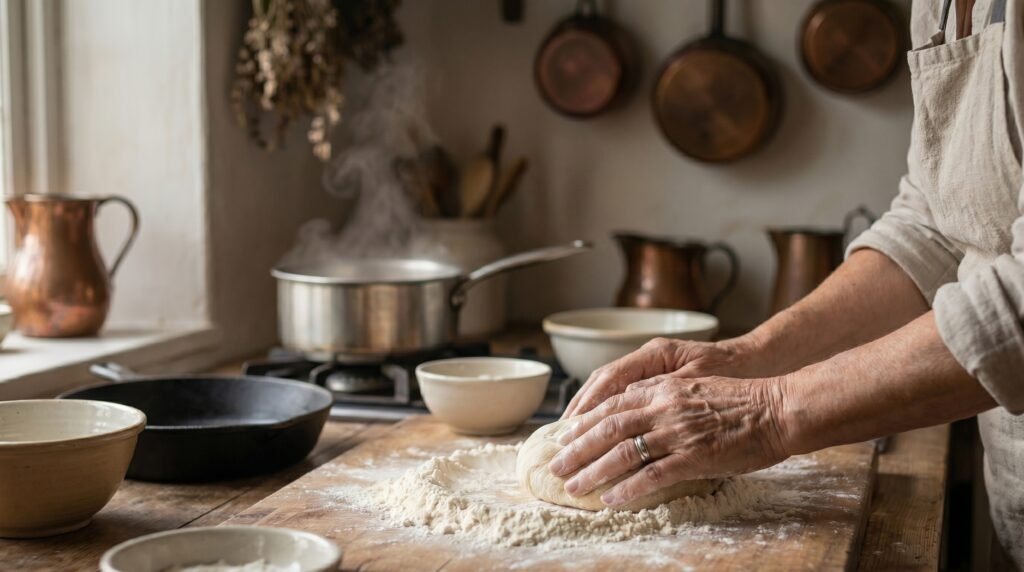
There is a moment — every cook who was taught this way knows it — where the dish stops being a sequence of steps and starts being a conversation with the dead. Not in any mournful sense. In a good one. You are stirring a pot that was stirred before you were born, and somewhere in the steam is the trace of a person who loved someone enough to teach them this.
The writer M.F.K. Fisher, one of the great recorders of the table’s emotional life, once wrote that the art of eating well is nothing more than the art of living well. The kitchen, she understood, is not a room where food is produced. It is a room where people are remembered and made whole.
Cooking as cultural memory works this way: the act of preparation is inseparable from the act of transmission. You are not just making soup. You are becoming the person who makes this soup. And one day — if you are lucky — someone will stand beside you and start to absorb without knowing they are absorbing. That is the ritual completing itself.
Bring the Ritual Into Your Own Kitchen: Five Practices That Last
You do not need to have been handed these traditions at birth to begin practicing them now. Ritual is built, not only inherited.
Call the question before you open a cookbook. Ask yourself what you know — not what the recipe says. Build muscle memory before you reach for confirmation.
Cook with your nose before your eyes. Garlic that has gone from raw to golden smells like a different ingredient entirely. Train yourself to notice these transitions by smell first. This is the oldest quality check in cooking, and the most reliable.
Keep a cooking journal, not a recipe log. Write down what surprised you, what you’d do differently, what your grandmother used to add that you forgot until this moment. A living record of your own observations is how you build personal ancestral kitchen wisdom.
Accept repetition as the practice. The same dish, cooked weekly, will teach you more than fifty different dishes cooked once each. Mastery lives in repetition. So does ritual.
Cook for someone. Ritual without witness withers. The passing of kitchen knowledge is social by design. Invite someone into the kitchen and let them watch before they participate. Begin the chain.
CONCLUSION
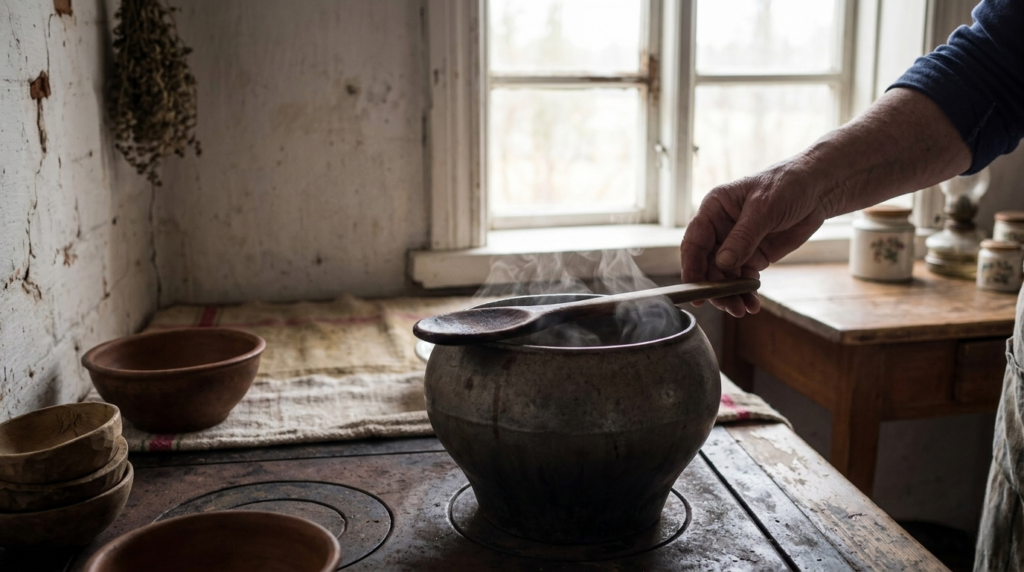
What we carry from a kitchen is rarely the exact recipe. It is the proportion of patience to heat. The understanding that food made slowly and with attention tastes different from food made efficiently. That some things cannot be extracted from the process without being lost entirely. Kitchen rituals passed down are not nostalgia — they are a form of continuity, a way of insisting that who we were matters to who we are becoming. Every time you press your hands into dough, lower a flame on instinct, or reach for the same pan your mother reached for, you are not simply cooking. You are answering a call that goes back further than you can see.