
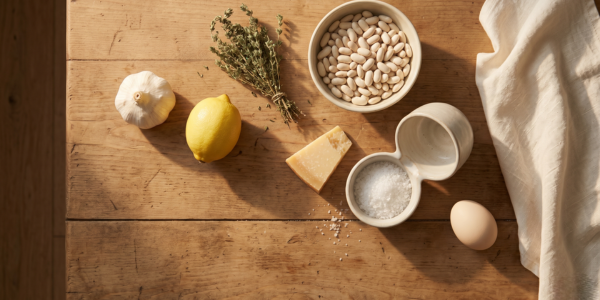
Before ovens had digital displays and before supermarkets offered forty varieties of olive oil, the world’s most beloved dishes were born of necessity — a handful of grains, a marrow bone, whatever grew by the door. The beauty of simple ingredients in traditional cuisine is not a nostalgic myth. It is a culinary truth: that restraint, applied with intelligence and care, produces flavors no long ingredient list can replicate. This article explores why simplicity is not poverty of means — but mastery of them.
The Art of Peasant Cooking: A History Written in Hunger and Ingenuity
The greatest culinary traditions on earth did not emerge from abundance. They emerged from its absence. The ratatouille of Provence, the ribollita of Tuscany, the daal of the Indian subcontinent, the miso soup of Japan — each was born in a rural kitchen where wasting even a wilted vegetable was unthinkable. Cooks of past centuries had no choice but to understand their ingredients at an atomic level: how salt drew moisture from eggplant, how slow heat transformed collagen into silk, how a crust of stale bread could give body to a humble broth.
This was not cooking by recipe. It was cooking by listening. Generations of mothers and grandmothers built a collective intelligence around a few dozen ingredients — and in doing so, they uncovered complexity that modern kitchens, overloaded with products and shortcuts, often fail to reach. The tradition of simple ingredients in traditional cuisine is, at its core, the history of humanity learning to pay attention.
Why Fewer Ingredients Produce More Flavor: The Principles Behind the Practice
There is a counter-intuitive truth at the heart of traditional cooking: when you add fewer ingredients, each one has to do more work — and to make it do more work, you have to actually understand it. This is the engine of flavor from technique, not complexity.
The most common mistake in home cooking is reaching for an additional spice or condiment to fix a dish that simply needed more time, better heat management, or the right salt moment. Adding complexity does not add depth — it adds noise. Here are the principles that separate skilled simplicity from plain simplicity:
- Seasoning in layers. Salt applied at every stage — raw, during cooking, at the end — builds cumulative depth that no single heavy pinch can replicate.
- The Maillard reaction. Browning food in a dry, hot pan before adding liquid creates hundreds of flavor compounds that boiling or steaming cannot produce. This is why a good sofrito, a caramelized onion, or a seared bone changes everything.
- Acid as a finishing tool. A squeeze of lemon or a splash of vinegar at the end of cooking brightens all the other flavors — not by adding something new, but by making what’s already there more visible.
- Time as an ingredient. The flavor of a slowly braised bean, a 24-hour marinated anchoiade, or a three-day ferment cannot be rushed. Traditional recipes with few ingredients are long precisely because time replaces complexity.
How to Cook Simply — and Cook Well: A Practical Guide
To cook with intention using traditional recipes built on few ingredients, begin with the ingredient itself. Hold it, smell it, press it. A ripe tomato at the height of August needs almost nothing — a little oil, a torn basil leaf, coarse salt. A tomato in February needs roasting at low heat for an hour before it will offer anything worth tasting. The season you cook in is the first variable; it changes everything that follows.
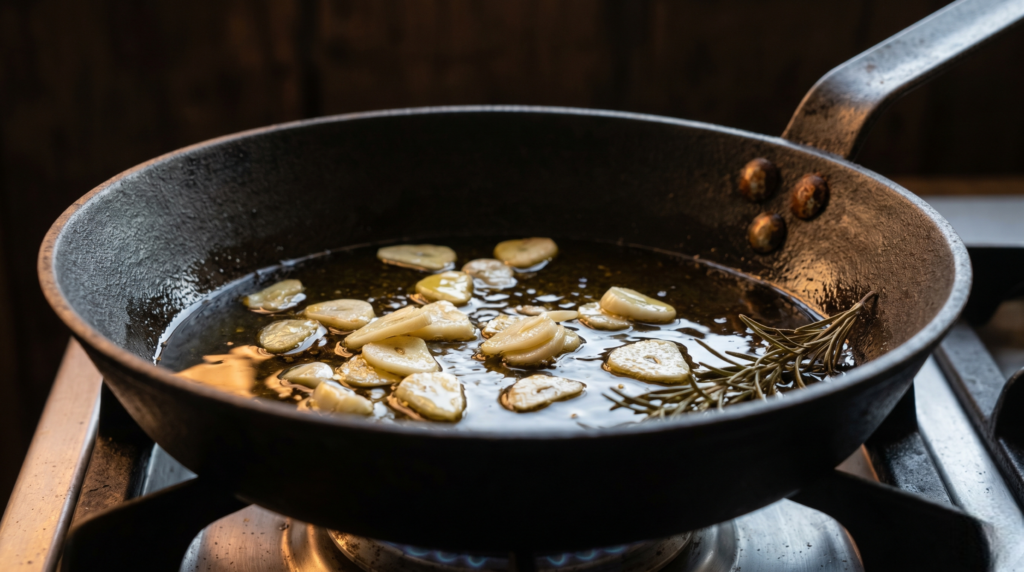
Start with a single technique and take it to its limit. Choose garlic, olive oil, and pasta. Now learn what happens when the garlic is barely golden versus deeply amber. Learn what happens when the pasta water — starchy and salted — enters the pan at different moments. Notice when the emulsion forms, when it breaks, and why. You will never make the same dish again. This is how rustic cooking with pantry staples becomes an advanced education.
The visual signs of success in simple cooking are subtle but unmistakable: the softening of a shallot into translucency, the moment a sauce reduces and begins to coat the spoon, the sound of a simmer that stays gentle instead of climbing to a boil. These are the tactile and aromatic cues that traditional cooks read as fluently as text. They are learnable — and they are the reward for slowing down.
The Quiet Power of a Handful of Beans
There is a particular pleasure in setting a pot of dried beans to soak the night before you need them. It is not efficient. It requires remembering. And that act of remembering — the quiet foresight of placing a bowl of water on the counter before going to bed — is a small but real form of care. For yourself, for whoever will eat what you cook.
“The most magical cooking always involves something given freely, and this is what distinguishes the cook who has soul from the cook who has only technique.” — Marcella Hazan
Simple traditional cuisine asks us to slow down in a world that rewards speed. The smell of a long-simmered broth filling a cold kitchen, the sound of dried thyme crumbled between palms — these are not aesthetic affectations. They are the texture of a life that includes cooking as a practice, not just a task. And that distinction, between practice and task, is where all the flavor lives.
Five Habits That Will Change How You Cook Simply
Keep a short pantry, not a full one. A well-stocked pantry of twenty ingredients you know deeply will serve you better than sixty you use once. Staples like good olive oil, dried legumes, preserved lemons, quality anchovies, and whole spices you grind yourself are multipliers — each one amplifies others.
Salt your cooking water generously. Pasta water, blanching water, and rice water should all taste of the sea. Seasoning from the inside of an ingredient — not just the surface — is the single most impactful habit you can build.
Rest before you taste. Dishes cooked with simple ingredients need a few minutes off the heat before their flavors settle and speak. Taste a braise at the boil, then taste it five minutes later, resting with the lid off. The difference is significant.
Learn one regional cuisine at depth. Rather than cooking globally with shallow knowledge, go deep into one tradition — the cooking of Liguria, of Oaxaca, of Sichuan, of Morocco. Traditional recipes few ingredients require a cultural lens to make sense, and that lens will give you a vocabulary you’ll carry forever.
Embrace imperfect vegetables. The tomato with a split skin, the carrot slightly soft, the leek with a yellowed outer leaf — these are not inferior. Cooked slowly with patience, they often carry more flavor than their pristine counterparts.
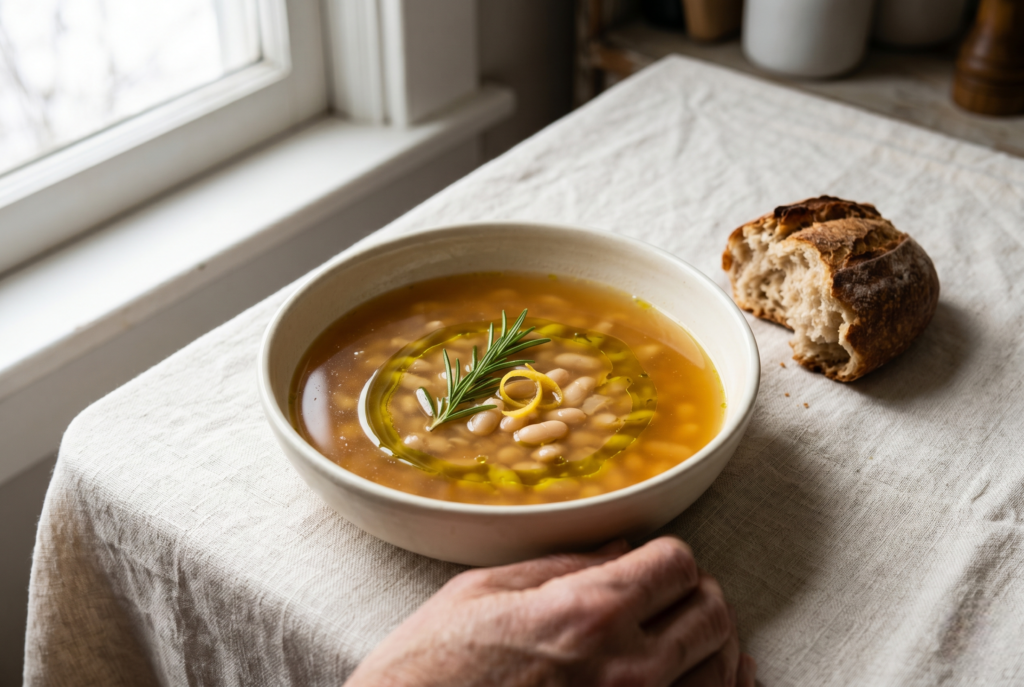
Every culinary tradition that has survived centuries did so because it carried something deeper than a collection of techniques — it carried a way of seeing the world. The cook who learns to find infinite possibility in a handful of legumes, a few aromatics, and the right amount of heat is not making do with less. She is practicing one of the oldest and most sophisticated forms of human intelligence: the ability to listen to what is already there, and to trust that it is enough. Start with what you have. Go slowly. Taste often. The rest follows.