
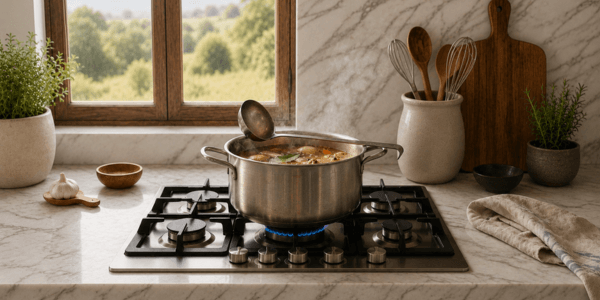
On a Sunday afternoon, in a kitchen with the windows cracked to let out the steam, a pot has been on low heat since before anyone woke up. Nobody is stirring it, and nobody is timing it. It has simply been, quietly, turning bone and root and water into something worth waiting for.
This is what slow simmering looks like when nobody is performing it for anyone: unglamorous, unhurried, and entirely sure of itself. In a country that gave the world the drive-thru window and the ninety-second breakfast sandwich, that small pot is its own kind of argument.
The Slow Cooking Tradition That Outlasted the Clock
Long before anyone measured a meal in minutes, most of the world cooked this way. A French farmhouse simmered its pot-au-feu for the better part of a day. A Vietnamese kitchen let its broth breathe over embers from dawn until the market closed. In a Southern kitchen, a pot of beans or greens might sit on the back burner from breakfast until supper, tended more than watched.
These were never separate traditions so much as the same idea, arrived at independently, by people who understood that some flavors have to be coaxed rather than rushed. The word restaurant, in fact, once meant something closer to remedy: the earliest restaurants sold little beyond a restorative broth, simmered low and slow.
Somewhere between that broth and the modern drive-thru, an entire philosophy of eating got compressed into a paper bag. Not wrong, exactly — just different. The long simmer never disappeared; it simply moved to the margins of the week, waiting for anyone willing to slow down long enough to notice it was still there.
What Patient Home Cooking Actually Requires
There is a common misconception that a slow simmer means a hard boil left unattended, or that it demands a specific dish rather than a way of paying attention. In truth, patient home cooking asks mostly for time and heat low enough that the surface barely trembles. A few things tend to separate a good long simmer from a rushed one:
- Heat below the boil. A gentle simmer breaks down what a hard boil would only toughen.
- Time treated as an ingredient. An hour rushed is not the same as an hour allowed to happen.
- A vessel that holds heat evenly. Uneven heat creates uneven results.
- Attention without hovering. Checking in occasionally beats constant stirring.
- Restraint with the seasoning. Flavors concentrate as liquid reduces, so early seasoning can overshoot.
None of this requires a special occasion — only believing that a pot left alone is not a pot being neglected.
Bringing the Long Simmer Into a Real Week
None of this has to live only in memory. Slow cooking also easily finds its rightful place, provided the first twenty minutes of effort happen early — browning what needs browning, adding water or stock, then simply leaving the kitchen. The pot does not need supervision; it needs permission.
Some people start it before the morning rush and return to a finished dinner by evening. Others let it go overnight, waking to a kitchen that already smells like the end of the day. The trick is treating the simmer as background rather than event — something happening at the edge of an otherwise normal afternoon. If this stirred something, Grandmother’s Kitchen: The Silent Wisdom Behind Every Dish carries that feeling into its own quiet territory. The long simmer asks for very little of the day it inhabits — only a small window at the start, and the trust to leave the rest alone.

The Quiet Between the Stirring
There is a particular silence that belongs to a simmering pot — not the absence of sound, but the absence of urgency. An occasional soft bubble breaking the surface. A window left open enough to let the smell drift into whatever room you happen to be in, so dinner announces itself hours before it arrives.
It is the same quiet whether the pot sits on a stove in July or in the deep cold of a British kitchen, where a Sunday joint turns slowly in the oven while a kettle stays warm within reach all afternoon. That stillness is not empty. It is full of everything that hasn’t happened yet — the table not yet set, the meal not yet finished becoming itself. Slow simmering, in the end, is less a method than a permission slip: to let something take the time it needs.
Everyday Ways to Let a Pot Take Its Time
Start earlier than feels necessary. Browning meat or vegetables before adding liquid builds a base flavor a fast simmer never has time to develop.
Choose a lid that fits loosely, if at all. A tight lid pushes a simmer toward a boil, while a cracked lid lets the liquid reduce properly.
Salt near the end, not the beginning. Flavors intensify as liquid cooks down, so early salting tends to overshoot.
Let it rest before serving. A long-simmered dish often tastes better once it’s had a moment to settle rather than being caught mid-motion.
Keep a small mental note of what worked. One long afternoon makes the next one easier, without needing anything more formal than memory.
I ignored my own pot for four hours once and came back convinced I’d ruined it — the liquid had reduced further than expected, and for a moment I stood there deciding whether to call it dinner or a mistake. It was dinner. Better, probably, for the neglect. I still don’t fully trust that lesson, even having learned it more than once.

Maybe the long simmer was never really about the pot at all. Maybe it was about proving, in some small daily way, that not everything worth having needs to happen quickly — that a country built on speed still leaves room, in its quietest kitchens, for the opposite instinct to survive. The pot on the stove doesn’t know it’s making an argument. It just keeps doing what it has always done, patiently, while the rest of the day rushes past it. Perhaps that’s reason enough to let one simmer again this week.
Jad