
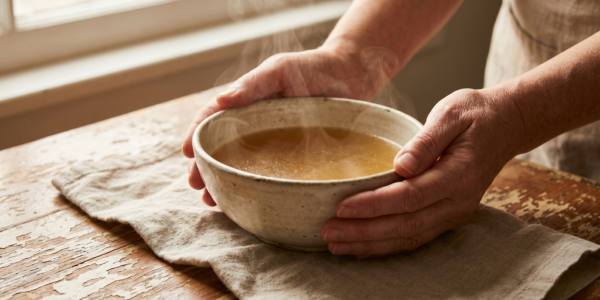
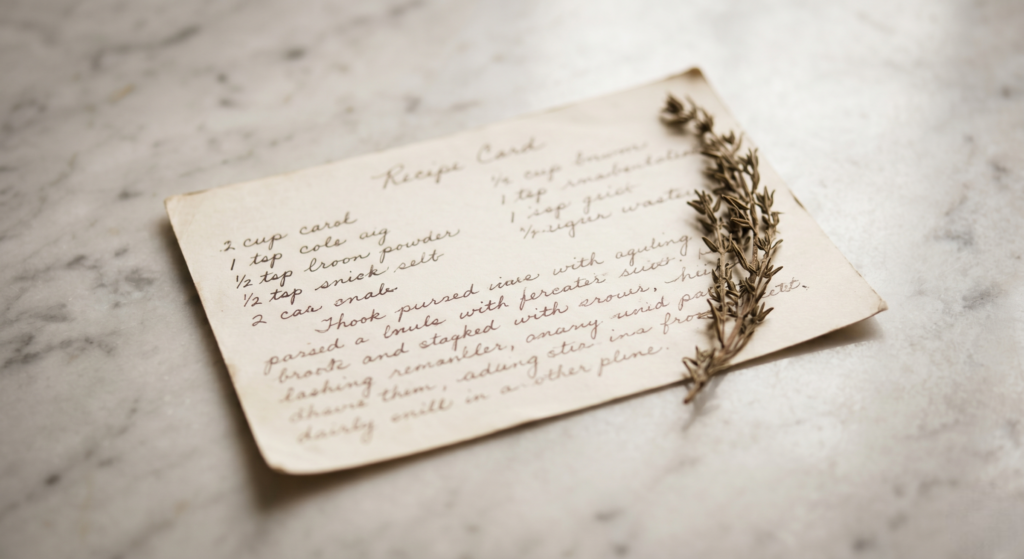
There is a soup your grandmother made that no restaurant will ever replicate. Not because the recipe is secret — you probably have it, written in her handwriting on a card gone soft at the edges — but because the recipe was never entirely the point. Emotional food memories are not simply fond recollections of a meal. They are full-body time travel: the creak of a kitchen chair, the exact quality of winter light through a particular window, the feeling of being utterly safe. No ingredient list accounts for that.
Food scientists have long studied flavor. Psychologists have mapped grief and joy. But it took neuroscience to explain why the two so often arrive together — and why, of all the senses, taste and smell carry the heaviest freight of the past.
The Olfactory Highway: An Ancient Architecture of Feeling
Long before Marcel Proust dipped his madeleine and conjured Combray in all its provincial fullness, human beings had been encoding survival information in flavor. The limbic system — the brain’s seat of emotion and long-term memory — evolved partly as an olfactory processor. In practical terms, this means smell and taste bypass the cognitive relay station that filters most sensory input. A scent does not think its way to your emotions. It arrives there directly.
Anthropologists studying food culture and identity across the Mediterranean, Southeast Asia, and the Andes have consistently found that the most emotionally resonant foods are not the finest or most elaborately prepared. They are the threshold foods: the first bites of solid food offered by a parent, the ritual dish that marks a holiday, the simple street food eaten on the day something important happened. Food, in this sense, functions as a kind of living archive — one that does not require literacy or language to preserve.
The Japanese concept of furusato — roughly, a longing for one’s hometown rooted in sensory memory — is built almost entirely around specific tastes: a grandmother’s miso, the particular sweetness of a regional persimmon. The tradition is not nostalgia in the Western clinical sense. It is cultural memory kept alive in the mouth.
What Neuroscience Actually Tells Us About Taste and Nostalgia
The Proustian phenomenon — a neutral term now used in memory research — describes the involuntary, highly vivid recall triggered by taste or smell stimuli. Unlike episodic memories retrieved through deliberate thought, these arrive unbidden and emotionally saturated. Researchers at the University of Toronto and the Monell Chemical Senses Center have both documented that olfactory-triggered memories tend to be rated as more emotionally intense and further in the past than memories triggered by other senses.
There are several mechanisms at work. The amygdala, which encodes emotional salience, is directly connected to the olfactory bulb — there is no comparable shortcut from, say, the visual cortex. When a smell or taste was first experienced during a moment of emotional intensity, that neural pairing is encoded with unusual durability. Stress hormones like cortisol and norepinephrine act as biological fixatives. A meal eaten on a perfectly ordinary Tuesday rarely becomes a touchstone. A meal eaten the day a loved one came home, or left, or died — that one tends to stay.
What this means practically for anyone who cooks:
- First exposures matter enormously — a child’s earliest experiences of a flavor will color how they receive it for life.
- Context is an ingredient — the same dish eaten in silence versus in celebration activates different neural circuits.
- Repetition consolidates meaning — the dish made every Sunday slowly accumulates emotional weight with each iteration.
- Temperature and texture are part of the memory, not background — warmth, in particular, codes as comfort through thermoreceptor pathways linked to early caregiving experiences.
How to Cook a Memory on Purpose
This is not as paradoxical as it sounds. While you cannot manufacture nostalgia — the emotional infrastructure must already exist — you can cook in ways that maximize the likelihood a meal will be remembered rather than merely consumed.
Start with smell. The Maillard reaction that browns an onion or a crust of bread produces hundreds of volatile aromatic compounds, and those compounds diffuse through a home long before anyone sits down to eat. The act of smelling food cooking is itself an emotional primer — it summons attention and awakens anticipation in a way that a finished plate set silently before someone never quite does. Cook with the windows closed, at least at the start.
Choose your moments. A birthday soup matters more than a birthday cake not because of flavor but because of the specific, deliberate attention it signals. Ritual foods earn their emotional weight through repetition across time. The first time you make a dish it is merely good. The fifteenth time, in the same bowl, in the same season, it begins to mean something.
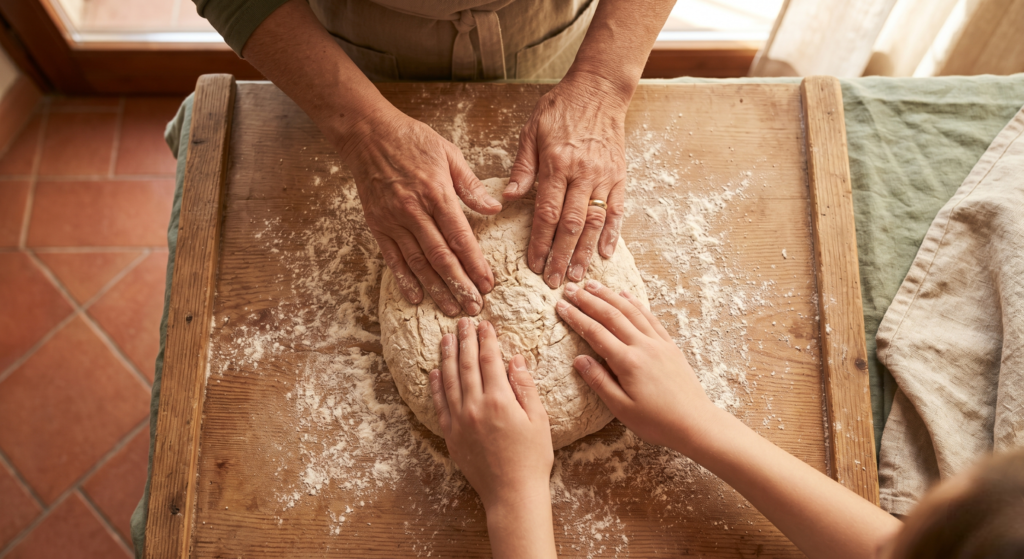
Involve other people in the preparation, even clumsily. Memory research consistently shows that active participation — stirring, tasting, seasoning with tentative hands — produces stronger encoding than passive reception. A child who helped peel the ginger remembers the dish differently from one who simply ate it. That memory lives in the hands as well as the mind.
Finally: resist the urge to perfect. The slightly burnt bottom of a socarrat, the irregular folds of a dumpling made in company — imperfection is part of the record. It is proof that something real occurred.
The Dish That Knows Your Name
There is a moment in cooking — not the tasting, not the finishing — when the smell of something changes in the pan, deepens, and the kitchen becomes briefly somewhere else entirely. A coast you visited once. A house that no longer exists. Someone who taught you without meaning to.
“Tell me what you eat, and I will tell you who you are.”— Jean Anthelme Brillat-Savarin, The Physiology of Taste, 1825
What Brillat-Savarin intuited, and what researchers are still mapping, is that food is not fuel with ceremony around it. It is the ceremony itself — a practiced, repeated act of making the world small enough to hold, fragrant enough to feel, warm enough to be in. The bowl you return to is not just a comfort. It is evidence that you were loved in a particular way, by a particular person, in a kitchen that smelled exactly like that.
Simple Ways to Make Your Cooking More Memorable
You do not need occasion to cook a dish that will last. But intention helps.
Cook the same dish at the same time every year. Annual repetition — a birthday broth, a Sunday roast in November, a particular jam made when a specific fruit is in season — works because time gaps sharpen contrast. Each iteration rhymes with the last.
Eat without screens at least some of the time. Memory consolidation is disrupted by divided attention. A meal eaten while watching something else is processed as background, not as event. The brain stores what it was paying attention to.
Write down what you made and who was there. Not a recipe — a note. “Made this for the first time when she was seven and it rained all afternoon.” The annotation becomes part of the dish. Future cooks will read it and understand something.
Let children eat the same food as adults. Age-segregated menus are a recent, Western, and — in terms of food memory formation — somewhat impoverishing invention. Shared plates create shared memories; different menus create different childhoods.
And finally: make food for people when they are grieving or celebrating, not only when they are hungry. The emotional context is what the brain will encode alongside the flavor. Cook into the moment, not around it.
Food memory is not sentiment. It is biology shaped by culture, passed between hands across generations, worn into the body the way a path is worn into grass — not by a single deliberate act, but by the accumulated weight of return. When you cook with attention — even once, even imperfectly — you are participating in something older and larger than any single meal. You are leaving a door open in someone else’s memory. They may not know it now. But one day, the smell of something browning in a pan will open it, and they will be briefly, completely, somewhere they have always wanted to return to.