
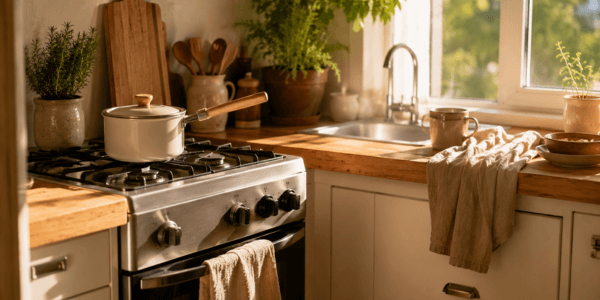
The kitchen measures maybe six feet from the window to the door. One burner still holds last night’s saucepan; the other waits for this morning’s eggs. A student in a third-floor walk-up moves through the space without thinking — hip against the counter, elbow finding the cabinet edge, a choreography learned in a week and kept for a lifetime.
We tend to speak of small kitchens as compromises, rooms we endure until something larger arrives. History quietly disagrees. For most of human memory, the small kitchen was not the exception. It was the kitchen.
The Long History of Small Kitchens, From Galley to Walk-Up
Consider the ship’s galley. For centuries, a cook in a room the size of a closet fed an entire crew, day after day, through storms that would empty a modern pantry onto the floor. Nothing about that space apologized for itself. Every hook, every rail, every pot had earned its place.
On land, the story repeats. The hearth corner of a rural cottage was rarely wider than an armspan, yet it warmed generations. In the tenements of early twentieth-century New York, immigrant families cooked feasts of memory on stoves smaller than a suitcase — recipes carried across an ocean, kept alive over two flames.
And in 1926, the Austrian architect Margarete Schütte-Lihotzky designed the Frankfurt Kitchen, barely six square meters, built on the radical idea that a compact room could be dignified, deliberate, and complete.
What ties these rooms together is not their size but their seriousness. They were not waiting rooms for better lives. They were where the living happened — and that lesson sits just as comfortably beside a two-burner stove in a dorm today as it did beside a coal hearth then.
What Cooking in a Small Space Actually Asks of Us
The most stubborn misconception about cooking in a small space is that it limits the cook. In practice, the constraint tends to work the other way: with less room for excess, what remains gets used, known, and trusted. The small kitchen does not shrink cooking. It concentrates it.
A few principles have held true from galley to studio:
One thing at a time: limited burners slow the cook down, and slower cooking is usually more attentive cooking.
Everything visible, everything honest: a small pantry cannot hide forgotten jars, so ingredients stay in rotation instead of in exile.
The counter is a commitment: when there is one working surface, clearing it becomes part of the recipe itself.
Tools earn their keep: an object that does only one thing rarely survives in six square meters, and the kitchen is calmer for it.
None of this is deprivation. It is closer to fluency — the difference between owning a language and owning a dictionary.
Bring the Small-Kitchen Mind Into Your Week
You do not need a tiny room to borrow its intelligence. Start with a single week lived by galley rules. Shop once, the way a ship provisions — a farmers market Saturday, a short list, nothing that cannot justify its shelf. Cook on one burner some evening, deliberately, and notice how the meal changes when it refuses to be rushed.
Give your counter the tenement treatment: cleared completely each night, so that morning arrives in an open room rather than yesterday’s leftovers of decision. Choose one pot to know deeply this month instead of five to know vaguely. These are not organizing tips. They are old habits of attention, practiced by people who never had the option of sprawl — and who ate remarkably well without it.
The morning corner of a small kitchen deserves its own ceremony too; if this stirred something, Creating a Calm Coffee Corner in a Tiny Kitchen carries that feeling into its own quiet territory.

The Room That Holds Everything
There is a particular feeling that only small kitchens produce. Stand in one while something simmers, and the whole room participates — the window fogs, the walls hold the warmth, the smell has nowhere else to be. Larger kitchens disperse their moments. Small ones keep them close.
Perhaps that is why the memory of a tiny kitchen outlasts the memory of a grand one. The room and the meal were never separate. It is the same closeness a Canadian winter kitchen knows in January, when the smallest room in the house becomes, briefly, the entire house. Six feet of counter, it turns out, is enough to hold a whole life. It always was.
Everyday Wisdom for the Smallest Rooms
Let the room set the menu, not the other way around: a small kitchen cooks certain things beautifully, and leaning into them beats fighting the space.
Keep one shelf slightly empty: breathing room is an ingredient, because a kitchen with no margin turns every meal into logistics.
End each day at zero: a cleared sink in a small room changes the entire morning, since there is no second room to escape to.
Cook your inheritance: the recipes that survived tenements and galleys were built for small rooms, and they still fit.
Resist the upgrade reflex: before wanting more kitchen, spend a season using all of the one you have — most of us never have.
I’ll admit something. I spent years apologizing for my first kitchen — one counter, a stove that leaned slightly left, a fridge that hummed like it had opinions. I cooked some of the plainest and happiest meals of my life there, and I didn’t notice until I’d moved somewhere bigger and found myself, some evenings, missing the hum. I still can’t fully explain that. Maybe rooms that hold us closely are simply harder to leave.

For a hundred generations, the small kitchen asked for less and gave more — heat, nearness, food that tasted like the people who made it. Whatever the size of the room you cook in tonight, it descends from galleys and hearth corners and third-floor walk-ups that never once felt sorry for themselves.
The inheritance is yours to use. And when the pot is washed and the light is low, remember that every big life starts somewhere warm a small door left open for you.
Jad & Cyprien