
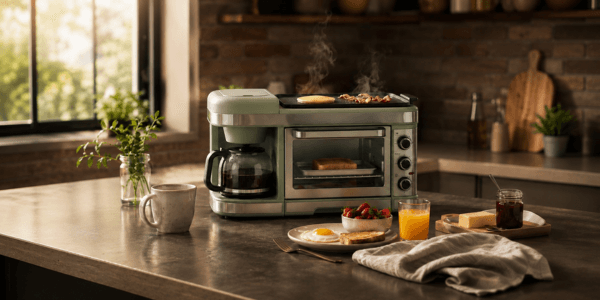
If you’ve ever tried to fit a toaster, a coffee maker, and a griddle onto twelve inches of counter space, you already know why breakfast stations exist. Here’s the thing — in a studio apartment, a dorm room, or an RV, every appliance has to earn its spot. A breakfast station promises to do the work of three gadgets while taking up the room of one. But not all of them deliver on that promise the same way. We’ve spent a good chunk of time reading through reviews, comparing specs, and thinking through what actually holds up to daily use. This guide walks through what matters when you’re choosing one — no jargon, no guesswork, just the honest basics.
What Does a Breakfast Station Actually Do?
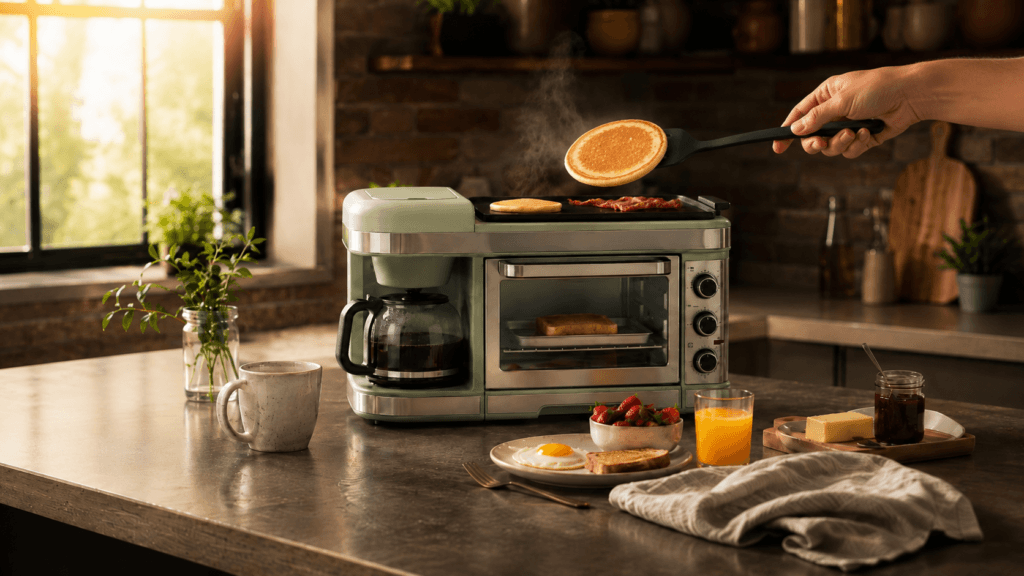
A breakfast station is basically a few small appliances built into one frame. Most combine a griddle or flat cooking surface, a toaster or mini toaster oven, and sometimes a coffee maker, all sharing one base and one power cord. The idea is simple: instead of lining up three separate gadgets along your counter, you plug in one unit and get most of a breakfast spread out of it.
That’s the appeal for anyone working with limited counter space. One footprint, one cord, one thing to store when you’re done. Some versions add a warming plate to keep pancakes warm while the eggs finish, or a small hot plate for sausage and bacon.
Worth noting — a breakfast station isn’t trying to replace a full kitchen setup. It’s built for the basics: eggs, toast, coffee, maybe pancakes. If your mornings involve more elaborate cooking, this probably isn’t the tool for that. But for straightforward breakfast routines in a tight space, it covers a lot of ground.
What Should You Look For in a Breakfast Station?
Once you start comparing them, breakfast stations range from pretty basic to genuinely clever. Here’s what actually makes a difference:
- Size and capacity. Measure your counter space before anything else — sounds obvious, but it’s the step people skip. Look at both the footprint (how much counter it takes) and the actual cooking capacity (can it realistically make breakfast for one person, or a family of four?). A unit that’s compact but only cooks two eggs at a time might not suit a bigger household.
- Material and build. Non-stick coatings on the griddle surface matter for both cooking and cleanup. Check whether the housing feels sturdy — some budget models have a flimsy, hollow feel that doesn’t hold up well over daily use. A heavier base usually means more stability while you’re flipping or pouring.
- Ease of use and cleaning. This one gets overlooked a lot. Removable plates or a griddle surface that lifts out for washing saves real time on busy mornings. If every part is fixed and you’re wiping around tight corners, that adds up over weeks of use.
- Features that matter (and ones that don’t). Adjustable temperature controls are genuinely useful — toast and eggs cook at different heat levels. A timer helps prevent burnt toast. On the other hand, extra attachments you’ll rarely use, like a built-in egg poacher you touch once and forget, mostly just add bulk and more parts to clean.
- Kitchen fit and storage. Even a compact unit needs somewhere to live when it’s off the counter. If storage is tight, look at the actual dimensions when it’s put away — not just how it looks in a photo. Some fold flat or sit low enough to slide under a cabinet; others don’t.
Weigh these against how you actually eat breakfast, not how you imagine you might use every feature someday.
What Mistakes Should You Avoid?
Honestly, most regrets we’ve come across boil down to a few repeatable mistakes.
The big one: buying based on looks alone. A sleek station photographs well, but the real test is whether it fits your counter and your actual daily routine. Measure first, then browse.
Second, people sometimes forget to check the wattage, especially in a dorm room or an RV with limited circuits. A high-wattage unit can trip a breaker if it’s sharing a line with something else. If you’re working with older wiring or a shared circuit, this is worth checking before you buy, not after you’ve already unpacked it.
Third — cord length and placement. Sounds minor, but a short cord on the wrong side of the unit can mean rearranging your whole counter setup just to reach an outlet. Last one: choosing the version with the most features instead of the one that matches how you actually cook. If you never make pancakes, a griddle plate sized for pancakes doesn’t help you — it just takes up storage space you didn’t need to give up in the first place.
Which Type Fits Which Kind of Kitchen?
Not every breakfast station fits every situation, and that’s fine — different setups solve different problems.
Studio apartment dwellers usually do well with a mid-size all-in-one unit — griddle, toaster, and coffee maker together — since counter space is the main constraint and having one plug for everything really helps.
Dorm room students tend to prioritize something simple and easy to store, ideally light enough to tuck under a bed or into a closet between uses. Lower-wattage models also make sense here, given shared circuits.
RV and van-life folks generally want something compact and low-power, since electrical capacity is limited on the road. A smaller footprint and manageable weight matter more here than having every possible feature.
Tiny kitchen homeowners — the kind with a single run of counter — often want something closer to a full breakfast spread: griddle, toaster, and a warming element, since they’re less limited by weight or portability and more by square footage.
None of these is the right answer across the board. It really depends on your space, your power situation, and how elaborate your mornings tend to get.
So, What’s Our Honest Take?
After going through all of this — size, materials, features, common mistakes — the pattern that keeps showing up is pretty simple. The stations that hold up well are the ones built around a few things done properly, not a long list of features nobody ends up using.
If we’re being real, that’s the lens we used when we went looking for the one we’d actually recommend. There’s one breakfast station we kept coming back to through this whole process, and it’s not because it does the most — it’s because it does the basics really well. We shared the whole story of why in our honest pick, including what won us over and where it falls a little short.
This guide is about the category as a whole. But if you want the specific one we landed on, that’s where to look next.
Frequently Asked Questions
Is a breakfast station worth it for a small kitchen? For most small kitchens, yes — a breakfast station covers the basics without adding three separate appliances to a limited counter. It mostly comes down to matching capacity to how many people you’re cooking for.
How much counter space does a breakfast station need? This varies by model, but as a general range, expect a footprint somewhere between a large toaster and a microwave. Measuring your actual counter space before buying is the safest approach.
Can a breakfast station replace a full stove? Not really. It’s built for breakfast basics — eggs, toast, pancakes, coffee — rather than full meal cooking. Think of it as a supplement to a kitchen, not a replacement for one.
Are breakfast stations safe to use in a dorm room? Many are, but it depends on the wattage and your dorm’s electrical setup and rules. It’s worth checking your building’s appliance policy and the unit’s wattage before assuming it’ll work.
How do you clean a breakfast station? Most have a non-stick griddle surface that wipes down easily once cooled. Models with removable plates tend to be easier to clean thoroughly than ones with fixed surfaces.
What’s the difference between a breakfast station and separate appliances? Mainly footprint and convenience — one unit, one cord, one thing to store, instead of three separate gadgets. The trade-off is usually a bit less capacity or flexibility than dedicated single-purpose appliances.
A Final Word
Choosing a breakfast station really comes down to knowing your space and your actual morning routine — not chasing every feature on the box. Measure first, think about how you really eat breakfast, and let that guide the decision.
Thanks for reading this far. We hope it made the decision feel a little less overwhelming.
Curated with care, Jad & Cyprien