

There’s a particular moment we both know well. You’ve decided you want a mini rice cooker. Simple enough. Then you open a search page and forty nearly identical machines stare back at you, and suddenly a small, warm decision feels like homework.
Here’s the thing — it doesn’t have to. The days are getting shorter now, the kind of season where a quiet pot of rice steaming on a tiny counter feels less like cooking and more like coming home. Whether that counter sits in a dorm, a studio, or a kitchen the width of a hallway, the right little cooker exists. And by the end of this guide, we think the choice will feel calm. Obvious, even.
The Quiet Checklist
Before a single product page, we’d gently ask you to answer three questions. No machine yet — just you and your actual life.
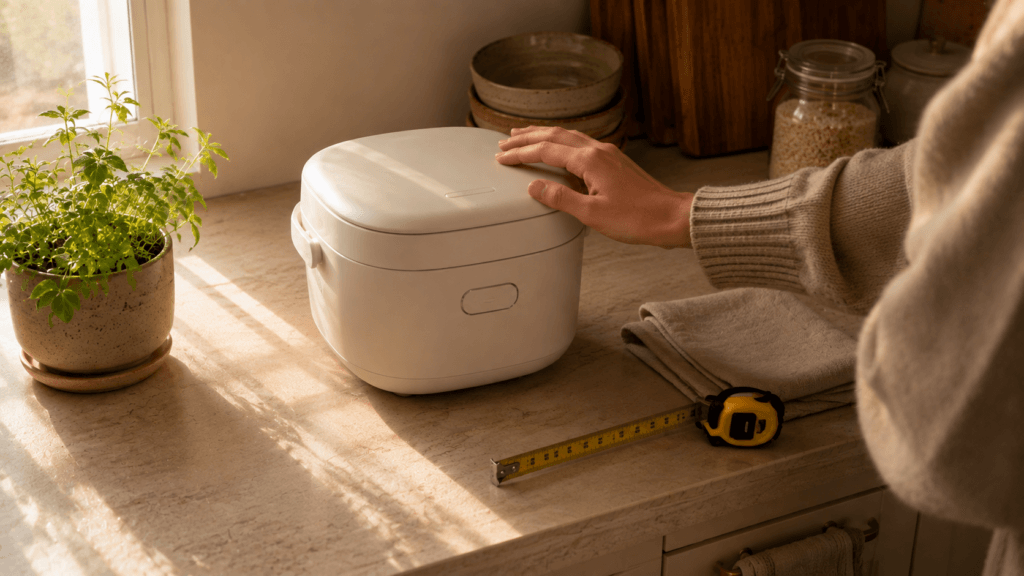
Your space: Where will it live? On the counter full-time, or tucked in a cabinet between uses? Be honest about the shelf you’re imagining. Measure it. Write the number down somewhere you won’t lose it.
Your habits: Are you cooking for one, mostly? One-and-a-hungry-roommate? Rice as a base for nearly every dinner, or a once-a-week comfort ritual?
Your frequency: Daily use changes everything. A cooker that hums along every evening deserves a slightly different decision than one that appears on Sunday nights only.
Worth noting: most of the regret we hear about in this category traces back to skipping these three questions, not to picking a “wrong” machine. The machines are mostly fine. The mismatch is what stings.
What Your Counter Already Knows
Mini rice cookers generally live in the one-to-three-cup range of uncooked rice, and honestly, for a solo cook or a pair, that’s a generous ceiling. The temptation is always to size up — “just in case.” We’ll be honest: in a small kitchen, “just in case” is how counters disappear.
A few pieces of small-kitchen arithmetic we’ve come to trust:
Footprint over capacity: A cooker’s base dimensions matter more day-to-day than its maximum yield. A compact round body that clears the underside of your cabinets will get used. A bulky one dragged out of a closet will not.
The cord question: In dorms especially, outlets are precious and oddly placed. A short, sensible run to the outlet is worth checking before you buy, not after.
Lid clearance: Some lids hinge upward and need headroom under shelves. It sounds trivial. It is not trivial at 7 p.m. when you’re hungry.
The warmer function: If your evenings are unpredictable — class runs late, the library keeps you — a keep-warm setting quietly earns its place. Rice that waits for you is a small kindness.
We wrote about this thinking applied to one real-world small-space scenario in Mini Rice Cooker for Small Kitchens — a companion piece to this guide.
Materials & Build, in Daily-Life Terms
We’re not going to take you into a laboratory here. What matters for choosing is how the common options feel across an ordinary week.
Nonstick inner pots: The everyday workhorse. Easy to rinse, forgiving on lazy nights, gentle on cleanup routines. The trade is simply care — soft utensils, no scouring.
Ceramic-coated pots: A similar ease with a different hand-feel, often a calmer look when the lid comes off at the table.
Stainless inner pots: Sturdier-feeling, happy with enthusiastic scrubbing, though rice can be a bit more attached to them, emotionally and literally.
Exterior finish: Matte bodies tend to hide fingerprints and steam spots; glossy ones photograph nicely and smudge honestly. In a kitchen where the cooker stays visible, this quietly matters.
None of these is a wrong answer. The question is only which kind of small daily maintenance you’ll genuinely do without resenting it.
Softly, About Money
We won’t invent prices — they shift, and you’ll see them soon enough. What stays stable is what changes between tiers.
Entry: One-touch simplicity. Cook, keep warm, done. For a first kitchen and straightforward rice, this tier is often quietly sufficient, and there’s no shame in it. There’s actually a kind of elegance in it.
Middle: Timers, texture settings, sometimes a steaming tray for vegetables above the rice. This tier suits the daily cook — the person for whom this machine becomes a small evening ritual.
Considered: Finer temperature behavior, quieter operation, more refined finishes. Lovely, genuinely. But in this category, the considered tier is a pleasure purchase, not a requirement. We’d rather you know that going in.
Here’s the thing about small appliances: the middle tier is where most people land happily, because it matches most lives. Buy for the life you have this autumn, not a hypothetical future one.
The Mistakes We See Most
Framed kindly, because we’ve made a few of these ourselves:
Buying for the dinner party that never comes: Oversizing is the classic. A big cooker half-full of rice for one person is just a machine taking up room, steaming slightly sadly.
Ignoring the cleanup: If the inner pot and lid parts aren’t easy to wash in a dorm sink, they won’t get washed promptly. Choose the machine your tired self can care for.
Falling for the button count: Twelve modes look impressive. Most people use two. Simplicity is not a downgrade — in a small kitchen, it’s often the whole point.
Forgetting the steam: These little machines breathe. Placing one directly under a low wooden shelf leads to a slow, damp regret. Give it an inch of open air.
Rushing the measurement step: The single most preventable heartbreak. The tape measure takes ninety seconds. It always wins.
The One Hesitation
We’d be pretending if we didn’t name it: “Couldn’t I just make rice in a pot on the stove?”
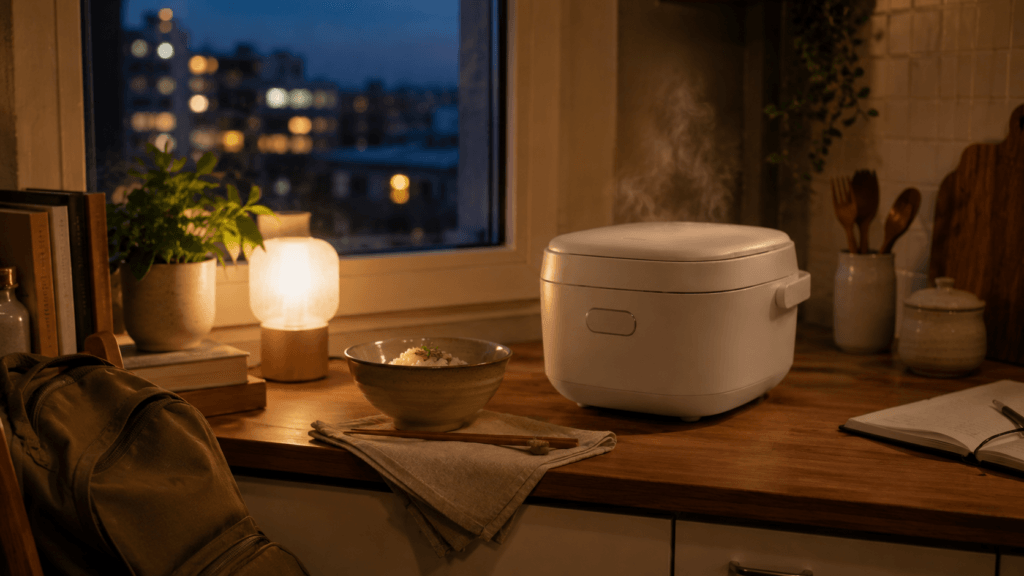
You could. People have for centuries. But the honest answer is about attention, not ability. A pot asks you to watch it. A mini cooker with a warmer asks nothing — it works while you unpack a backpack, call home, stare out at the early dusk. In a season of new schedules and small rooms, that unattended reliability is the actual product. You’re not buying rice. You’re buying one less thing to mind.
If that trade doesn’t move you, a pot will serve you well, and we mean that. But if your evenings are already full, the hesitation usually resolves itself by the second week of the semester.
Where This Guide Sits
This article is one room in a larger house. Our full map of the minimalist small-kitchen setup — the wider view this guide feeds into — lives here: The Complete Minimalist Small Kitchen Guide for Tiny Spaces. When it opens, everything connects.
Closing
So: three honest questions, a tape measure, a clear-eyed look at your tier, and one small machine that hums quietly while the light fades earlier each evening. That was the promise — a calm, obvious choice — and we hope it feels that way now.
The rice will be warm when you get home. That’s the whole idea.
Jad & Cyprien