
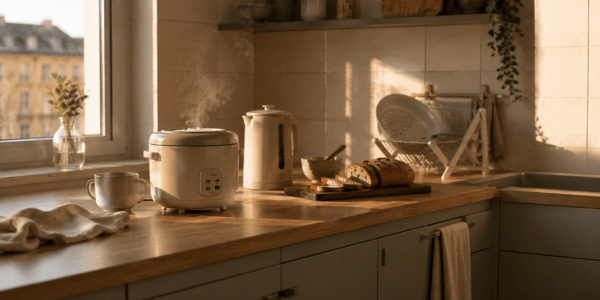
Here’s the thing about small kitchens: everyone talks about what they lack. Fewer cabinets, less counter, no room for the stand mixer you weren’t going to use anyway. We’d rather talk about what they hold — because a four-square-meter kitchen, chosen carefully, can feel wider than a showroom.
We’re Jad & Cyprien, two kitchen enthusiasts who have spent an unreasonable amount of time thinking about tiny counters. Dorm rooms, studio apartments, RV galleys, first flats with a kitchen the width of a hallway. The pattern we kept noticing: the smaller the space, the more each object matters. One wrong purchase and the counter disappears. One right one and the whole room settles.
So this is our map. The complete one. Every compact appliance, folding tool, and quiet detail we’ve written about in this little universe lives here, in one place, in an order that makes sense. Our promise is simple: by the end, you’ll know exactly which corner of this world to walk into first — and your tiny kitchen will feel less like a compromise and more like a choice.
No rush. Small kitchens don’t do rush.
Understanding the Minimalist Small Kitchen: What Actually Matters
Before any product enters the picture, a few truths make every later decision easier.
Counter space is currency. In a small kitchen, every object pays rent in square centimeters. The question is never “is this nice?” — it’s “does this earn its footprint every week?” An appliance used daily justifies permanent residence. One used monthly should fold, stack, or live in a drawer.
One job done quietly beats five done loudly. Multi-function machines tempt small-space dwellers, and sometimes they’re right. But honestly, a compact tool that does one thing well — boils, brews, steams — tends to be smaller, simpler, and calmer than the gadget promising everything.
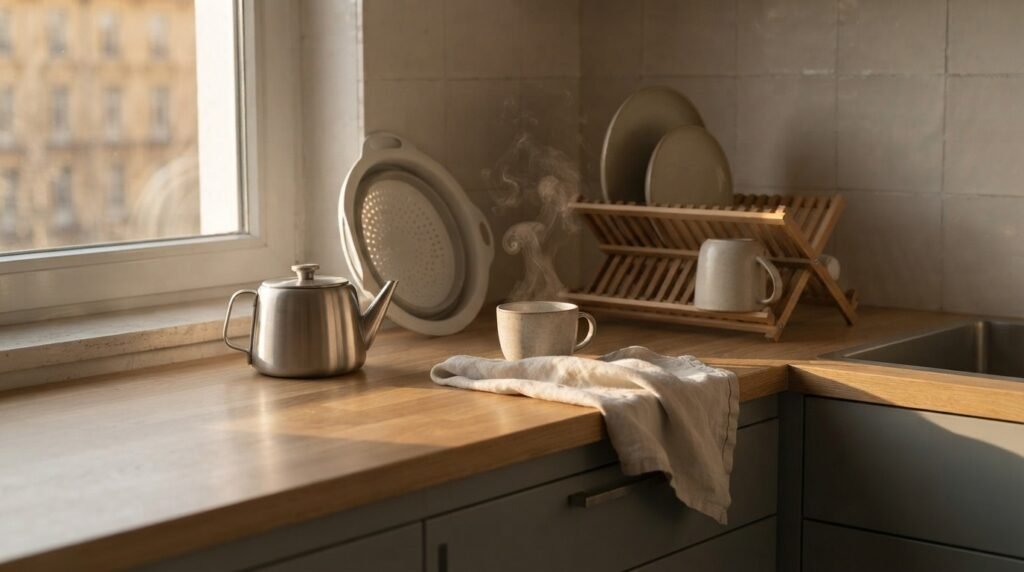
Vertical and foldable logic wins. The smartest small-kitchen objects have a second shape: a colander that goes flat, a rack that fits a windowsill, a board narrow enough to live against the backsplash. Think in silhouettes, not just functions.
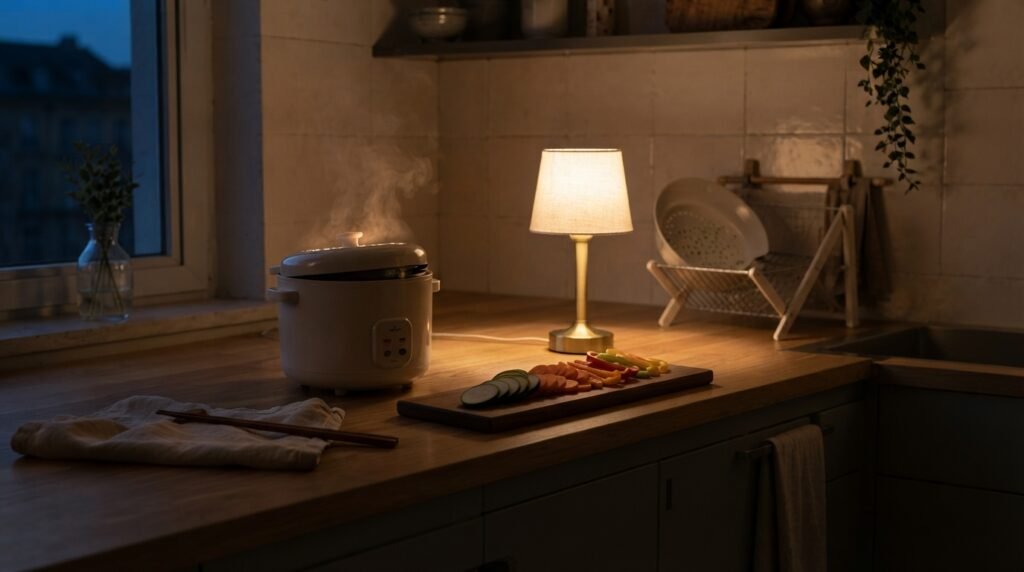
Atmosphere is equipment too. We’ll be honest — we didn’t believe this at first. Then we wrote about light. A small kitchen with warm, layered lighting feels expansive; the same kitchen under one cold ceiling bulb feels like a closet. What you can’t add in meters, you can add in mood.
Hold these four ideas, and most of the choices ahead become almost easy.
Our Honest Method
Full transparency, because trust is the only thing this page is really built on: we are not chefs, not product testers, not engineers. We’re two enthusiasts who research deeply and buy small.
Our method, plainly:
We read widely before we write. Specifications, materials, real dimensions — checked against the realities of tight counters and dorm outlets.
We study review patterns, not single reviews. One glowing comment means little. Two hundred people independently mentioning the same lid quirk means a lot.
We apply real-kitchen logic. Would this survive a shared student kitchen? Does it fit under a low cabinet? Can one person clean it in a sink the size of a salad bowl?
We skip what we can’t verify. No invented numbers, no borrowed marketing claims. When something is a specification, we say so; when it’s our impression from research, we say that too.
That’s the whole method. Modest, but honest — and in a corner of the internet full of noise, modest and honest felt like the point.
The Landscape, Simply
The minimalist small kitchen isn’t one category; it’s a small ecosystem. Here’s the plain map of what exists, before we walk you through each door.
The quiet workhorses — compact cooking appliances that replace a stove’s role: mini rice cookers, small electric hot pots. For anyone cooking real meals in unreal square footage.
The morning anchors — the single-serve coffee maker, the small kettle. Tiny footprints, outsized daily presence. Usually the first purchase, rarely regretted.
The space negotiators — objects competing for the same spot, like a slim toaster versus a mini treat maker. This is where comparisons matter more than catalogs.
The folding prep corps — collapsible colanders, compact salad spinners, narrow cutting boards. Tools with second shapes, made for drawers instead of shelves.
The finishers — dish racks sized for counters with nothing to spare. Unglamorous, decisive.
The atmosphere layer — light itself, treated as a kitchen tool. The least discussed, possibly the most transformative.
Each direction suits a different starting point: students outfitting a dorm from zero, couples decluttering an existing galley, or anyone who simply wants mornings that feel less like logistics. The cluster map below takes them one by one.
The Cluster Map — Every Door in This Small World
Twelve articles, one universe. We’ve ordered them by their weight in the cluster: the central pillars first, then the satellites, companions, and the accessories that finish the picture. Each entry tells you what waits inside and who it’s for.
The Rice Cooker That Started It All
Some objects define a space, and in our small-kitchen world, this compact rice cooker is one of them. The article walks through why a machine built for tight counters settles so naturally into the lives of singles and couples living light — the footprint, the simplicity, the way dinner stops being a negotiation with a stove.
It’s written for anyone whose kitchen has more ambition than surface area, and for whom “real meal, tiny space” isn’t a contradiction. If your counter is waiting for its first quiet workhorse, this is the story of one. The full piece is here: Mini Rice Cooker for Small Kitchens.
Choosing That Rice Cooker Wisely
Knowing a mini rice cooker exists is one thing; choosing yours is another conversation entirely. This calm buying guide covers the sizing logic (what capacity actually means for one or two people), materials worth caring about, honest budget brackets, and — our favorite part — the mistakes we’d rather help you sidestep before money leaves your pocket.
It serves the reader standing one step before purchase: interested, slightly overwhelmed, wanting a steady hand rather than a sales pitch. That steady hand lives here: How to Choose a Mini Rice Cooker for Small Kitchens.
One Cup, Three Sizes, Zero Clutter
Mornings in a small kitchen deserve better than a bulky carafe machine hogging a third of the counter. This piece looks at a single serve coffee maker curated precisely for tight spaces — three cup sizes, an iced setting for warmer days, and a silhouette slim enough to live beside the sink without apology. It’s for the solo brewer, the dorm dweller, the couple with exactly one coffee drinker.
If your morning cup is the day’s first quiet moment, the details are waiting: Single Serve Coffee Maker.
When Light Is the First Ingredient
The most unexpected article in this cluster, and honestly one we’re proudest of. No appliance here — just four square meters and the quiet work light does in them. A lamp, a window, a golden hour: this story traces how lighting turns a tiny galley into the calmest room in the home.
It’s for readers who sense their kitchen’s problem isn’t equipment at all, and for anyone who has stood in a beautiful small space made cold by one bad ceiling bulb. The whole meditation is here: Small Kitchen Lighting: when light is the first ingredient.
Real Meals Without a Stove Nearby
Dorm rooms and stove-free studios have their own culinary reality, and this compact electric hot pot was built for it. The article takes a closer look at what such a machine genuinely handles — actual cooked meals, not just instant noodles — and where its limits sit. It serves students most of all, but also anyone whose kitchen simply lacks burners and refuses to lack dinner. A small pot carrying a surprisingly large promise, examined honestly: A Mini Electric Hot Pot.
Three Questions Before the Hot Pot
Companion to the piece above, this buying guide slows the decision down in the best way. Size logic for dorm and small-kitchen life, materials that matter at this scale, honest money talk, and three questions we suggest answering before anything gets ordered. It’s written for the almost-buyer — the reader who has fallen a little for the idea of a mini hot pot and now needs the practical half of the romance. The three questions, and everything around them, are here: How to Choose a Mini Electric Hot Pot .
The Spinner That Behaves Itself
Salad prep in a small kitchen usually means wet leaves, wet counters, and a plastic contraption too big for any cabinet. This piece covers a stainless steel spinner — 6.34-quart capacity per its specifications, transparent lid, non-slip base — and what it quietly contributes to a calm, minimalist setup. It suits anyone who eats fresh often enough to want the job done properly, in a tool that looks at home on open shelving. Worth noting: it’s sturdier company than its plastic cousins. The full look is here: Stailess steel salade.
The Counter Duel: Toaster vs. Treat Maker
Two small appliances, one available spot — a genuinely small-kitchen dilemma. This comparison lays out a slim toaster and a mini treat maker side by side: which one earns the permanent counter position, and why the runner-up might still deserve a drawer. No winner declared for you; instead, an honest framework for deciding based on how your actual mornings and weekends unfold. For anyone staring at one empty square of counter with two contenders in the cart: Toaster or treat maker.
A Small Morning Anchor
Every tiny kitchen we’ve admired had one thing in common: a kettle that pulled more than its weight. This article gives an honest look at a 1.0-liter, 900-watt stainless steel model — fast boiling per its specifications, compact enough for dorm desks and mini counters, and the kind of object that quietly organizes a morning around itself. It serves tea drinkers, pour-over people, instant-oatmeal students, and anyone who believes hot water is the beginning of most good things: Small electric kettle.
Where the Dishes Go to Dry
Nobody dreams about dish racks, and yet the wrong one ruins a small counter faster than any appliance. This roundup presents two compact racks suited to small kitchens, dorms, and RVs — quiet solutions for surfaces with genuinely no space to lose. It’s for the reader whose sink corner has become a permanent puddle, and who suspects the fix costs less than a rethink of the whole kitchen. Both picks, plainly compared, live here: Two small kitchen dish.
The Colander That Disappears
Bulky drainers are the classic small-kitchen thief — used ten minutes a week, hoarding shelf space all seven days. This piece covers a flat-folding colander that drains pasta and produce like a full-size version, then collapses into a drawer and vanishes. It suits anyone applying the “second shape” rule to their kitchen: if it can fold, it should. A small, satisfying fix for a stubborn old problem: Collapsible colander.
A Board with a Biography
We end the map with its most personal entry — a story, not a spec sheet. A narrow walnut cutting board earns its place in the smallest kitchens, and this article tells that life plainly: the craft behind it, the patina it develops, the quiet care it asks in return. Written for readers who want at least one object in their kitchen with soul, and who suspect that wood remembers. The daily companion’s story, told whole: A walnut cutting board.
Gentle Missteps to Sidestep
Every small-kitchen journey includes a few wrong turns. Here are the ones we see most, offered kindly — we’ve made half of them ourselves.
Buying for the kitchen you wish you had. The family-size appliance “for someday” will spend years blocking the kitchen you actually live in. Buy for this counter, this year.
Ignoring the second shape. Two objects with identical functions can differ wildly in stored silhouette. The one that folds, nests, or stands upright always wins the long game.
Filling every surface because it’s there. Empty counter isn’t wasted counter — it’s workspace, breathing room, and half the reason minimalist kitchens feel calm.
Treating light as an afterthought. The cheapest transformation in this entire guide involves no appliance at all. A cold overhead bulb undoes everything the decluttering achieved.
Chasing multi-function everything. Sometimes the five-in-one machine is genius. Often it’s three functions you’ll never use wrapped around two done poorly. Single-purpose and small is a legitimate philosophy.
None of these are catastrophes. They’re just detours — and now you can skip them.
A Calm Path to Deciding
Twelve doors is a lot of doors. Here’s our honest routing, depending on where you stand.
Starting from zero — a new dorm, a first studio? Begin with the workhorses. The rice cooker piece shows what one good machine changes, and its buying companion, how to choose a mini rice cooker, makes the purchase itself unhurried.
Kitchen exists, mornings are chaos? The coffee maker and kettle articles are your pair. Small objects, disproportionate peace.
Space is the enemy, not equipment? Go straight to the folding prep corps — colander, spinner, dish racks. Quick reads, immediate relief.
Everything works but nothing feels right? That’s the light talking. Small kitchen lighting:when light is the first ingredient is the article we’d hand you first, and possibly the only one you need this week.
There’s no wrong order. This page will still be here.
Where This Table Leads Next
When this small kitchen has found its calm, a new question tends to follow it out the door each morning — and next season, our table turns toward The Packed Noon: lunch carried quietly, and the gentle art of desk and commute calm.
Closing
We promised you a complete map, and here it is: twelve articles, one philosophy, zero wasted centimeters. The minimalist small kitchen was never about having less — it was about every single thing earning its place, and the deep quiet that follows when it does. Wherever you entered this page, we hope you leave it knowing your first door.
Jad & Cyprien