
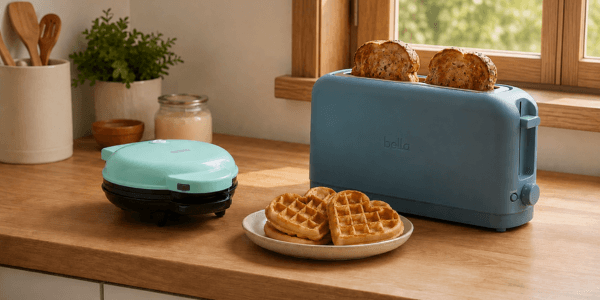
There’s a particular kind of hesitation that shows up in small kitchens: the counter has room for one more thing, maybe two, and every appliance has to justify itself. A toaster feels obvious — until it’s standing in the same conversation as a treat maker that promises donuts, waffles, and cupcakes out of one small machine, and the obvious answer gets a little less obvious.
We get some version of this question often enough that it felt worth sitting with properly. Not “which one is better” — that’s not really what a small kitchen is asking. The real question is closer to: which one earns its spot in your kitchen, on your mornings. By the end of this, that should feel obvious for your kitchen specifically, whichever way it lands.
It’s a familiar scene either way — a dorm shelf, a studio kitchenette, a first apartment with exactly one stretch of counter that isn’t already claimed by dishes or a drying rack. Whatever the appliance, it has to earn that stretch honestly, not just look good sitting on it.
A small note while we’re here: a couple of the links ahead are ones we may earn a little from, at no cost to you. We’d rather say that plainly than not.
The Common Ground
Before comparing them, it’s worth naming what these two actually share, because it’s more than it looks. Both are small-kitchen appliances in the truest sense — compact, single-purpose-ish, built for people whose kitchen doesn’t have room for anything it doesn’t genuinely use.
Neither one asks for much. Both plug in, do their one job, and get tucked away or left out without ceremony. That’s really the qualifying bar for anything on a small counter — not “is it impressive,” but “does it pull its weight often enough to deserve the square footage.”
Where they part ways is in what “pulling its weight” means for each of them. One stands in for something you’d likely do daily anyway. The other stands in for something you might not do much at all without it. That’s the actual fork ahead, worth sitting with before either product gets its own turn.
There’s also a quieter shared trait worth naming: neither one pretends to be more than it is. A slim toaster isn’t trying to be a full breakfast station, and a treat maker isn’t trying to replace an oven. Small kitchens tend to reward that kind of honesty in an appliance, because there’s no room left over for anything overselling itself.
The bella Fits-Anywhere Toaster — The Path It Offers
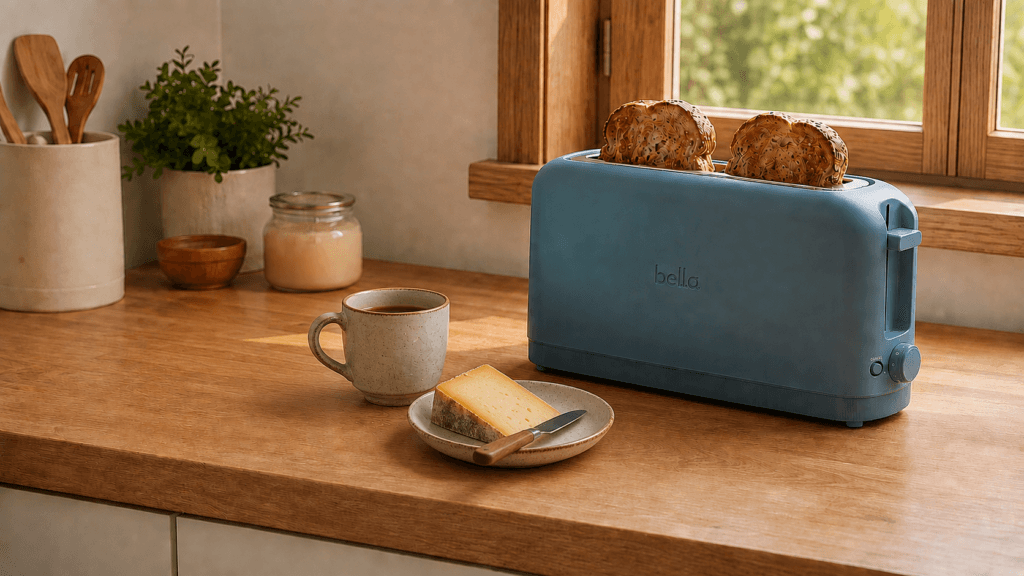
The bella toaster’s whole pitch is right there in its own name — Fits-Anywhere, slim, extra wide. It’s built for the counter that has only a narrow stretch to spare, and needs that stretch to work hard. The long slot and extra-wide design mean it isn’t precious about what goes in: bagels, thick-cut bread, whatever the morning has on hand, not only the thin stuff.
In Surf blue, it reads more like a small object chosen on purpose than an appliance being merely tolerated. That distinction matters more in a small kitchen, where everything sits in plain view simply because there’s nowhere to hide it.
What it offers, at its core, is the path of least friction — two slices, every day, without a decision attached to it. It’s the kind of appliance that disappears into routine so completely that it stops being noticed, right up until the one morning it’s missing, and toast turns out to matter more than expected.
There’s a case to be made that this is the harder kind of appliance to design well, precisely because nobody’s excited about a toaster. The excitement, if there is any, comes later — in the fact that it never once becomes a chore, never demands a plate swap or a moment’s thought before the coffee has kicked in. Slim and extra-wide sound like small details until the counter in question genuinely doesn’t have inches to spare.
The Dash MultiMaker — The Path It Offers
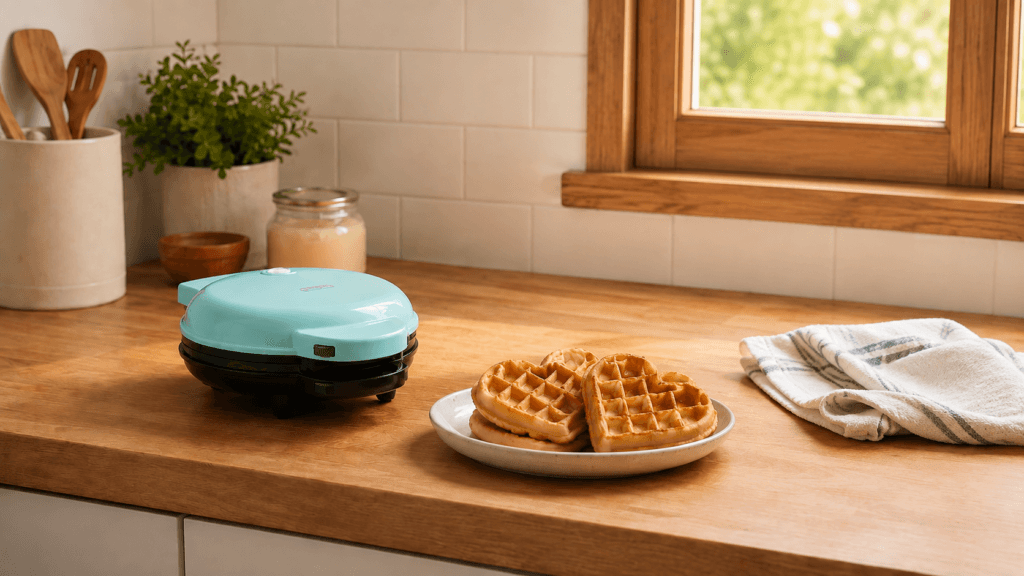
The Dash MultiMaker offers a different kind of path entirely — not routine, but variety held in reserve. One small machine that, depending on which plates go in, becomes a donut maker, a cupcake maker, or a heart-shaped waffle maker. That’s a genuinely different promise than “toast, reliably”: it’s “treat, occasionally, without needing three separate appliances to get there.”
The interchangeable plates and dishwasher-safe parts do quiet, important work here. A small kitchen can’t really absorb an appliance that also demands a complicated cleanup ritual, so that detail earns more credit than it might in a roomier kitchen. In Aqua, it carries a bit of personality — more toy-adjacent than tool-adjacent, in the nicest possible way.
What it offers is the path of occasional joy — the thing that turns an ordinary Saturday into a small event, without needing to be used daily to justify its spot.
There’s something worth naming about appliances built around a treat rather than a staple: they tend to get remembered fondly rather than merely relied on. Nobody tells a story about their toaster years later, but a kitchen that occasionally produced heart-shaped waffles for no particular reason tends to stick around in memory a little differently. That’s not a small thing for a kitchen that’s otherwise built entirely around efficiency.
Can They Coexist?
Honestly, in a genuinely tiny kitchen, “coexist” isn’t automatic, and it’s fair to ask before bringing both home. Two appliances sit easily on a counter with any real length to it. It’s a harder ask on a single dorm shelf or a kitchenette with one true outlet strip.
Where space allows even modestly, the two don’t really compete for the same job, which helps their case. One handles the daily, unglamorous task. The other handles the occasional, celebratory one. Neither is fighting the other for the same three minutes of a Thursday morning.
Where it does get tighter is storage, not use — two boxy appliances take real cabinet space even while neither is plugged in. Worth being honest about that before either one comes home.
A reasonable middle path, if the counter is genuinely tight: let one live out and the other live tucked away, brought out on its own schedule. That way the daily one stays effortless and the occasional one stays a little bit of an event, which is arguably the whole point of it anyway.
The Differences That Actually Matter
A few forks worth naming plainly, without turning this into a spec sheet:
| bella Toaster | Dash MultiMaker | |
| Daily role | Everyday, expected | Occasional, special |
| Counter presence | Slim, made to tuck in | A little bolder, a small centerpiece |
| What it asks of you | Almost nothing — plug in and go | A bit of planning, a plate swap |
| Cleanup | Straightforward | Easy, thanks to dishwasher-safe parts |
| Personality | Quiet and dependable | Playful and occasional |
None of these differences make either appliance more correct than the other — they just point toward different lives. A kitchen that skips breakfast most days but hosts often might genuinely lean toward the MultiMaker first. A kitchen anchored by a steady morning routine leans toward the toaster — though “leans toward” here just means it fits that particular rhythm, not that it wins anything.


The One Hesitation
The doubt that tends to survive all of this: is a treat maker really worth the space if it only comes out once in a while? Fair question, and there’s no invented number here to settle it neatly — just this: an appliance used occasionally but genuinely enjoyed isn’t dead weight. It’s a small kept promise to a slower version of a week.
If that promise doesn’t feel real for a given kitchen, that’s useful information too. Not every counter needs an occasional-joy appliance, and there’s no failure in a kitchen built entirely around the reliable stuff.
It helps to picture an actual month rather than a single day when weighing this. A toaster gets asked to perform roughly the same task some number of mornings out of thirty. A treat maker might get asked once, or a handful of times, and still be worth its shelf on the strength of those few mornings alone — the math here isn’t really about frequency so much as what each use is worth to the household doing it.
Our Quiet Matching
If mornings run early and mostly on autopilot → the bella toaster fits that rhythm without asking anything extra.
If the kitchen is small but the weekends carry a little more give → the Dash MultiMaker earns its shelf space on those days alone.
If the counter genuinely has room for both, and neither role above feels optional → there’s a version of a small kitchen where the two sit side by side, each doing the job the other doesn’t.
Where This Comparison Sits
This particular hesitation is one small piece of a larger question — what a minimalist, small-format kitchen actually needs, versus what it can happily skip. The Complete Minimalist Small Kitchen Guide for Tiny Spaces holds that fuller conversation, for whenever it’s ready.
A Small Decision, Kindly Made
Whichever one comes home, the goal was never to own more of anything — only to own the right thing for how this particular kitchen already lives.
Jad & Cyprien