
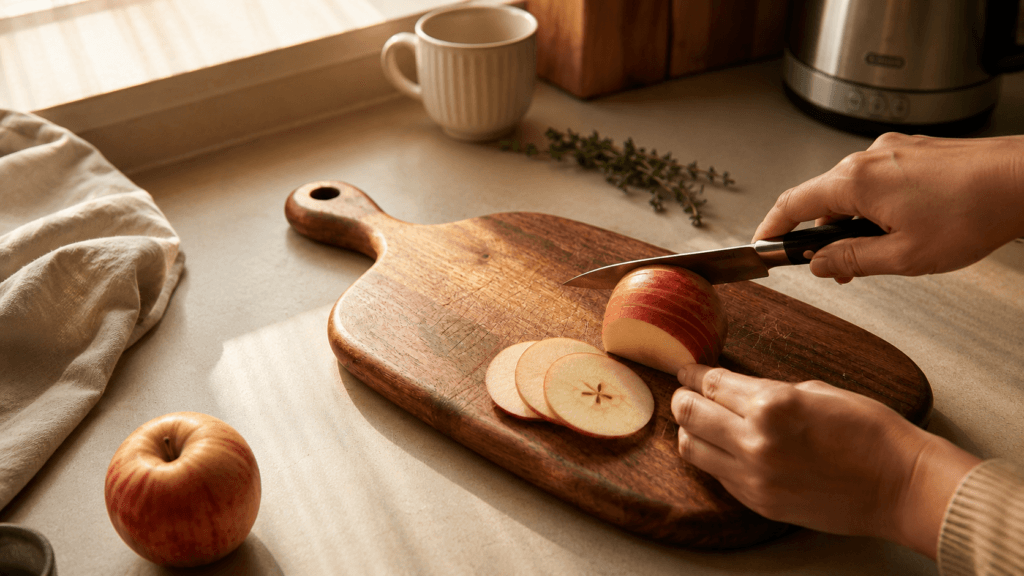
The apple gives way with a soft knock — steel meeting walnut, the sound a small kitchen makes when it’s working. The counter here is barely wider than a windowsill, wedged between a hot plate and a drying rack, and yet the narrow walnut cutting board asks for nothing more. Two hands frame it. A thumb rests near the handle, worn smooth at the edge.
Outside, early light crosses a studio window and lands exactly where the knife does. Nothing about this moment is large. Everything about it is enough.
Where the Walnut Cutting Board with Handle Comes From
Walnut has long been a furniture-maker’s wood — dense, close-grained, dark enough to hide its labor. For generations, the boards that ended up in kitchens were often born in workshops as offcuts: pieces too handsome to burn, planed flat, given a handle, and sent home. The handle itself is older than convenience. Before counters had drawers, a board lived on a nail by the hearth, hung within reach, drying in the room’s warmth between meals.
That lineage is why a handled board still feels different from a slab. It was made to move — from wall to counter to table — in kitchens where space was borrowed, not owned. Somewhere along the way, the shape found its truest home again: the galley apartment, the shared flat, the dorm with its single stretch of laminate. The wood never changed. The rooms just got small enough to remember why the handle was there.
What Makes a Small Wooden Chopping Board Itself
Pick it up and the first surprise is density. Walnut carries more weight than its size suggests, and that heft is its manner — the board doesn’t skid, doesn’t chatter under the knife, doesn’t need to be held down. It simply stays.
People tend to misjudge its kind twice. First, they assume a small board is a lesser board, a compromise waiting for a bigger kitchen. In truth, a narrow board is a decision: it leaves room for the cup, the bowl, the elbow. Second, they assume wood is fragile — when a well-kept hardwood surface quietly mends, its shallow knife marks closing as the fibers swell with each oiling.
What its character amounts to, hand to grain:
A knock instead of a clack — the muffled, woody sound each cut makes
Grain that deepens from cocoa to near-black wherever oil has soaked in
A handle that polishes itself against palms, season after season
The faint sweetness of fresh oil the morning after it’s fed
Edges that soften to the touch long before they ever look worn
None of this is performance. It’s temperament — the reason a board like this gets kept.
Living a Week on Six Inches of Walnut
Monday, it’s toast and a pear before an early class, the board pulled off its nail while the kettle mutters. Wednesday, it becomes a tiny serving plank — cheese, crackers, a sliced apple for a friend perched on the other stool. Friday night it holds garlic and scallions for a one-pan dinner, then gets rinsed, wiped, and hung before the pan has even cooled. The board never leaves the room. In a kitchen this size, nothing does.
Care, here, isn’t a chore so much as a small closing ceremony. A quick wash in warm water, never a soak. A towel pass along the grain. Back on the nail, where air can reach both faces. Once in a while — usually a slow Sunday — a spoonful of oil rubbed in with a scrap of cloth, the wood drinking it down and darkening like weather moving across a field.
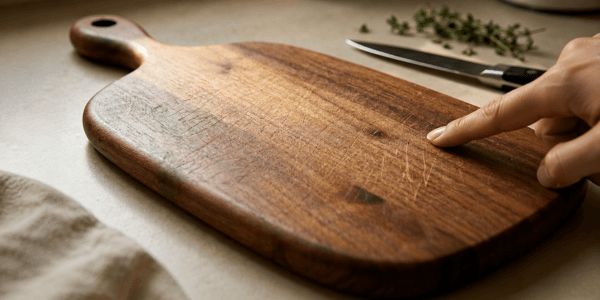
You can read a well-loved board the way you read a face: the pale patch where lemons get squeezed, the fine crosshatching where the knife lands most, the deepening color that says someone stayed. The ritual this board serves each morning owes half its calm to the way light falls across it — a story we tell in Small Kitchen Lighting: When Light Becomes the First Ingredient.
The Long Acquaintance
There is a particular comfort in an object that ages at your pace. A phone is obsolete in three years; a walnut board is barely introduced. Keep one through a lease, a move, a second move, and it becomes a rare kind of witness — the same surface under the first dinner you cooked alone and the hundredth.
It’s a habit kitchens keep wherever they run tight: a bedsit above a laundrette, a harbor flat with one gas burner, the board rinsed and hung back on its nail as the last act of the evening. The wood holds the record quietly. You don’t notice it happening until, one evening, you reach for the handle without looking — and your hand already knows where the worn edge will be.
Caring for a Board of Its Kind
A few habits keep any small hardwood board good for decades, and each has its reason. Wash it by hand in warm water and dry it standing or hanging, because trapped moisture is the only enemy wood truly fears — a soaked board swells unevenly and remembers the insult. Oil it whenever the surface looks pale or feels dry to the fingertip, since a fed board resists stains and odors that a thirsty one drinks in.
Rub a halved lemon and coarse salt across it now and then; the mild scrub lifts what soap misses without wearing the grain. Let it rest off the counter between uses so both faces breathe evenly and the board stays true. And leave the knife marks alone — they’re not damage, they’re the record of a surface doing exactly what it was made for.
One board is a companion; a whole small kitchen that breathes this easily is another matter, and it’s the ground we cover in The Complete Minimalist Small Kitchen Guide for Tiny Spaces.
We almost sanded ours back to new, once. It had a scorch mark from a careless pot and a stain shaped vaguely like Ohio, and for a week we told ourselves a fresh surface would feel better. Then we noticed we’d stopped seeing them as flaws — the scorch was the night friends stayed too late, the stain was beets in January. We oiled the board instead. Some evidence you keep.
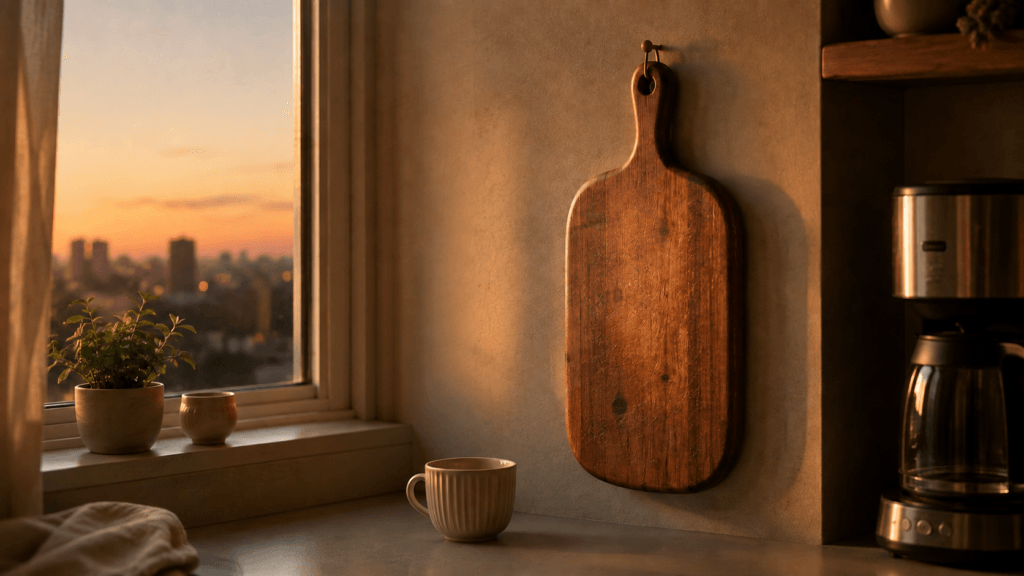
A cutting board outlives the meal, the semester, sometimes the address. It earns its place the slow way — not by promising anything, but by being there when the knife comes down and gone to its nail when the counter needs to be a desk again. Small kitchens teach a patient kind of ownership: fewer things, known deeply.
If this one narrow piece of walnut can hold a whole household’s mornings, imagine what a room full of such companions feels like. Every kept object came from somewhere — ours wait where the door stands open for you, quiet as oiled wood at dusk.
Jad & Cyprien