
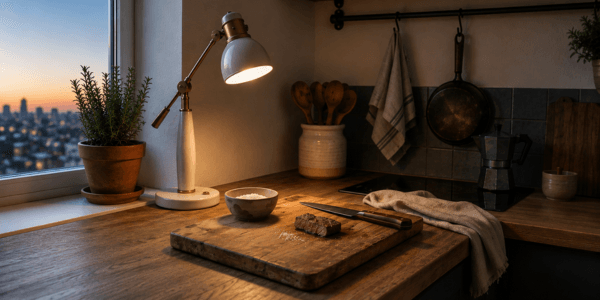
The kettle ticks. Somewhere below, a delivery truck sighs at the curb, and the first bar of sun clears the fire escape and lands — exactly there — on the lip of your cup. In four square meters, small kitchen lighting stops being a fixture and becomes a flavor: it warms the butter dish before your hands do, gilds the rim of yesterday’s bowl, makes the steam visible so you can watch your coffee breathe.
You haven’t flipped a switch. You don’t need to. The window is doing the cooking this morning, and all it asks is that you stand still long enough to notice.
The Golden Hour Kitchen Ritual We Keep Returning To
You know that moment when a painting stops you? Vermeer understood it four centuries ago: a woman, a pitcher, a window, and light doing all the talking. The old diner counters at dawn understood it too — that amber wash over chrome and coffee, the day still deciding what it wants to be.
And somebody’s grandmother kept one small lamp burning over the sink long after the dishes were done, because a lit kitchen is a kept promise.
But this isn’t about them. It’s about you, right now, in a kitchen you can cross in two steps. The smaller the room, the louder the light. A beam that would go unnoticed in a sprawling open plan becomes an event here — it has one counter to find, one cup to crown.
That’s the quiet advantage nobody mentions when they measure your square footage: in a tiny kitchen, the golden hour has nowhere else to go. It comes straight to you.
The Quiet Mechanics of a Cozy Studio Apartment Kitchen
Here’s what’s actually happening when the room feels calm: your eye is resting. One warm source, a few honest shadows, nothing shouting. And here’s how it slips away — usually without anyone deciding it should.
The overhead panel goes on out of habit and flattens everything into a waiting room. A blue-white bulb turns your counter clinical. A drying rack camps on the sill and swallows the only window you have.
The mechanics are small, which is exactly why they work:
One warm bulb, kept low: light at counter height, not ceiling height, pools instead of pours — the room gathers around it the way people gather around a fire.
A clear sill: whatever daylight you’re given needs a runway; three inches of open windowsill can double the felt brightness of the whole room.
Shadows on purpose: a room lit evenly everywhere feels lit nowhere; let the corners go soft so the counter can matter.
A truce with the overhead: keep it for scrubbing and searching — for everything else, let the small lamp carry the evening.
None of this costs a renovation. Most of it costs a habit.
Follow the Light for One Week
Start tomorrow, before opinion kicks in. Notice where the sun lands first — the actual spot, the six inches of counter it chooses — and put your cup there. That’s the whole assignment for day one. You’re not redecorating; you’re learning your kitchen’s schedule the way you’d learn a friend’s.
By midweek, add the evening half. Lamp on before you start cooking, overhead off, and pay attention to what changes. The onions sound the same, but you’ll swear they don’t. The room shrinks in the good way — down to the cutting board, the flame, your two hands. Dinner for one in a walk-up starts to feel less like logistics and more like company.
You’ll know it’s working by the senses, not the checklist: you start reaching for the lamp switch the way you reach for the kettle, without thinking. Steam looks slower. You linger at the counter after the plate is empty. The kitchen at 7 a.m. and the kitchen at 7 p.m. become two different rooms, and you’re glad to know both.
And if you start wondering how a room this small learned to hold this much — that same feeling lives a little differently in Why Small Kitchens Have Always Fed Big Lives?
The Feeling Beneath the Glow
There’s a reason candlelight makes strangers speak softly. Low light lowers the stakes. It says: nothing here needs to be finished tonight. In four square meters, that message lands fast — there’s no far wall for it to get lost against.
Somewhere across the water, right now, a kettle in a London bedsit is catching this same slant of late sun, and someone is standing over it the way you’re standing over yours. The room doesn’t know it’s small. It only knows it’s lit, and someone stayed.
That’s the feeling beneath all of it, really. Not design. Not optimization. Just the oldest signal a home can send: the lamp is on, which means someone is here, which means the day — whatever it did — ends warm.
Keeping It Alive
Rituals fade politely, so give this one a few anchors:
Tie the lamp to the kettle: pairing a new habit with an old one is how it survives busy weeks — light and water go on together.
Wipe the window monthly: a film of city grime dims more than you’d think; clean glass is free light.
Move with the seasons: the sun’s landing spot drifts through the year — let your cup drift with it instead of mourning the old spot.
Keep one bulb warm-toned, always: consistency is what turns a lighting choice into a feeling you can count on.
When you’re ready to see how the whole small-kitchen philosophy fits together — the light, the space, the quiet logic of less — that’s what The Complete Minimalist Small Kitchen Guide for Tiny Spaces Guide holds.
Our own version is imperfect, for the record. Jad’s kitchen faces north, so the golden hour arrives secondhand, bounced off the building across the street — ten borrowed minutes, most days. Cyprien’s lamp has a dented shade from a move neither of us will take blame for, and it throws a lopsided circle we’ve both grown attached to.
We didn’t design any of this. We just stopped turning on the big light, and the rooms got kinder.
Tonight the lamp will click off last, after the dishes, after the quiet. Tomorrow the sun will clear the fire escape at nearly the same minute and land on nearly the same inch of counter, faithful as any recipe. Four square meters, one window, one bulb — it turns out that’s all calm ever needed. Not more room.
Just more light, arriving on schedule, and someone there to meet it. And when the evening finally settles, some hours are simply The Mini Rice Cooker for Small Kitchens — this one always knows the way back.
Jad & Cyprien